


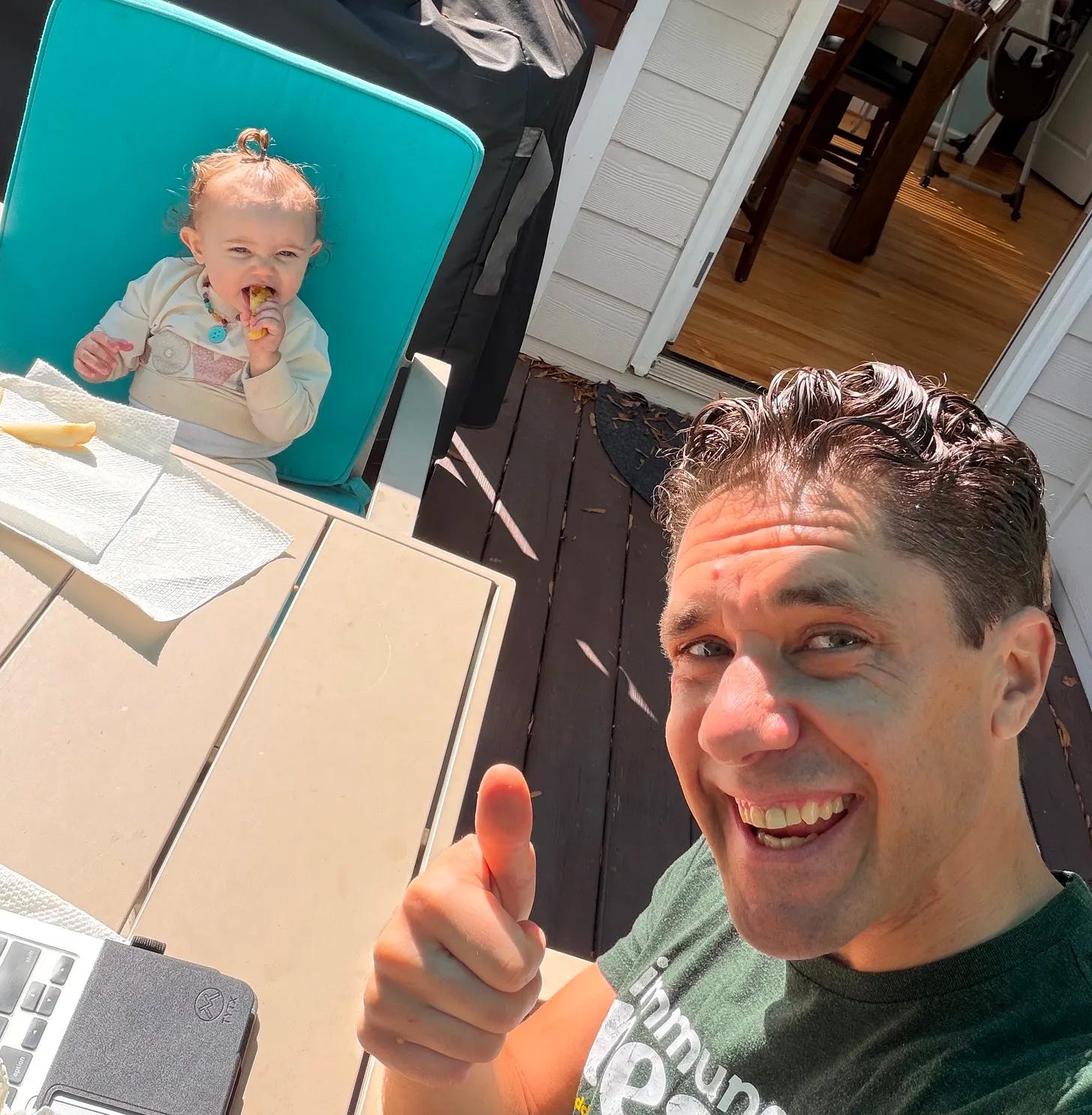
Unseasonably warm in November, so I’m working on the deck today with my little buddy. 🙂
Baby Beth loves being outside, soaking up the sun and eating her pears. Anything to give Mama a little break and spend some time with my baby girl.
Not sure if we’re done at 7 kids, but if life has taught me one thing, it’s to savor every minute you can. That’s what Thanksgiving is really asking of us. It isn’t one big meal. It’s a habit of noticing the gifts God has already put right in front of you.
God wired your brain to get better at what you practice. Practice thankfulness, and you start seeing more to be thankful for which is what this piece is all about...
When Israel crossed the Jordan River into the Promised Land, God told Joshua to do something that seems small at first. He had twelve men carry stones out of the riverbed and set them up as a memorial, so the next generation would ask what they meant.
“When your children ask in time to come, ‘What do those stones mean to you?’ then you shall tell them that the waters of the Jordan were cut off before the ark of the covenant of the LORD.” — Joshua 4:6-7
God knew His people would forget, so He built remembering into their lives and into the land itself.
Joshua told the people why the stones mattered, and the reason reached far beyond Israel’s own families.
“…so that all the peoples of the earth may know that the hand of the LORD is mighty, that you may fear the LORD your God forever.” — Joshua 4:24
Gratitude can shape your brain because God designed your mind to be renewed by what you repeatedly set it on.
Research links practicing thankfulness on purpose with better mental health and sleep, and Scripture has always tied a thankful heart to a clear mind and a thankless one to darkened thinking.
What follows is what Scripture says about remembering, what researchers have found when people practice thankfulness on purpose, and three simple ways to start stacking your family’s stones…
You Were Made to Remember
“I will give thanks to the LORD with my whole heart; I will recount all of Your wonderful deeds.” — Psalm 9:1
To recount is to remember out loud, and the psalmist made a decision to rehearse what God had done until his heart followed his words.
Forgetting is our default, which is why Scripture is full of commands to remember, to tell our children, to set up stones and to keep feasts. Moses warned Israel about this right before they entered a land of plenty:
“Take care lest you forget the LORD your God by not keeping His commandments and His rules and His statutes, which I command you today.” — Deuteronomy 8:11
Jesus built remembering into the center of our faith too. At the Last Supper He took bread, gave thanks and said, “Do this in remembrance of Me” (Luke 22:19), so every time we come to His table, thanksgiving and remembering come together.
David knew his own heart was prone to forget, so he preached to himself.
“Bless the LORD, O my soul, and forget not all His benefits.” — Psalm 103:2
Then he named those benefits one by one: God forgives, heals, redeems, crowns and satisfies (Psalm 103:3-5). Gratitude starts the same way for us, with a decision to stop and remember out loud what God has already done.
When your mind already has twenty tabs open before breakfast, this is where to start…

Gratitude Leaves a Mark
Researchers at Indiana University worked with adults who were starting counseling for anxiety or depression. Some wrote letters of gratitude for a few weeks and others did not, and three months later the letter writers showed greater gratitude-related activity in the medial prefrontal cortex, a region involved in decision-making and social thinking.
It was a small study, and the brain scans were taken only at the end, so no one can say exactly how much changed. But practicing thankfulness seemed to make people more sensitive to gratitude months later, which suggests the habit shaped the person.
A larger study from many of the same researchers points the same direction. In a randomized trial of 293 adults seeking counseling, the people who wrote gratitude letters reported better mental health four weeks and again twelve weeks after the writing ended than people who wrote about their stressful experiences or received counseling alone.
People rated their own mental health, and the letters were added to counseling rather than replacing it.
Still, it was randomized, which is the strongest kind of test, and the result lines up with how Paul opened letter after letter by thanking God for the people he was writing to (Philippians 1:3).
That fits what Paul described when he wrote about being transformed by the renewal of your mind (Romans 12:2). God designed your mind to be shaped by what you repeatedly set it on.
Paul also warned what happens when the opposite takes root. Describing people who knew about God and still refused to thank Him, he wrote this:
“For although they knew God, they did not honor Him as God or give thanks to Him, but they became futile in their thinking, and their foolish hearts were darkened.” — Romans 1:21
Notice the order in that verse, because the refusal to give thanks came first and the darkened thinking followed. Scripture ties a thankless heart to a clouded mind, and the research on gratitude keeps pointing the other way.
In one study of 401 adults in England, the people who scored higher in gratitude reported better sleep quality, longer sleep and less trouble falling asleep.
The researchers traced the link to what people were thinking about as they drifted off, since grateful people carried more positive thoughts to bed and fewer anxious ones.
And it fits what Paul told the Philippians, to think about whatever is true, honorable, lovely and worthy of praise (Philippians 4:8).
Romans 12 called it renewal long before anyone had a brain scanner. We dug into what the research is catching up to here…

“I’m grateful to be here, receiving encouragement, recipes, and whole-body transformation. Even after trying times, I trust you and Mama Z. The spiritual aspect completes the system: body, soul, and spirit.”
— Ellen D.
Thanksgiving Is How a Grateful Mind Is Built
“Rejoice always, pray without ceasing, give thanks in all circumstances; for this is the will of God in Christ Jesus for you.” — 1 Thessalonians 5:16-18
Notice that all three commands are ongoing, because rejoicing, praying and giving thanks are daily practices, and daily practices shape who we become.
Israel learned the cost of forgetting the hard way. God parted the sea and saved them, yet “they soon forgot His works” (Psalm 106:13), and the grumbling started almost as soon as the singing stopped.
Asaph learned this in a season when he wondered whether God had forgotten to be gracious (Psalm 77:7-9). Here is how he found his way back to hope:
“I will remember the deeds of the LORD; yes, I will remember Your wonders of old. I will ponder all Your work, and meditate on Your mighty deeds.” — Psalm 77:11-12
Every time you thank God for something specific, you’re stacking another stone. Over time, those stones build a mind that notices God’s goodness first.
Stones also outlast moods, so on the days when your heart feels flat, you can walk back to the pile you’ve already built and read the record of what God has done.
Gratitude grows best when it’s specific.
“Thank You for everything” is a fine prayer, but naming the exact answer to prayer, the exact meal or the exact person builds a stone you can see.
“Thank you so much for everything you all do, and especially today for the Scriptures. I really needed those today.”
— Mary G.
Stack Your Family’s Stones This Week
The stones at the Jordan were built for children’s questions, and your Thanksgiving table can do the same work.
When your children hear you name what God has done, they learn to see His hand in their own lives too.
“One generation shall commend Your works to another, and shall declare Your mighty acts.” — Psalm 145:4
Moses gave parents a plan for that kind of passing down, and it fits inside an ordinary day.
“And these words that I command you today shall be on your heart. You shall teach them diligently to your children, and shall talk of them when you sit in your house, and when you walk by the way, and when you lie down, and when you rise.” — Deuteronomy 6:6-7
Sitting, walking, lying down and rising covers most of a family’s day. You don’t need a special program to teach gratitude, because the kitchen table, the car ride and bedtime are already on your calendar.
Here are three simple ways to start stacking your family’s stones this week:
Name one specific blessing at dinner each night, and let every person share.
Write it down. Keep a list on the fridge through Thanksgiving, and read it together on the holiday.
Build a memorial. Have each person write one blessing on a small stone or card, and set them in a bowl on your Thanksgiving table.
None of it takes long, and all of it adds up, one specific thank You at a time.
A Prayer for You. 🙏
Father, thank You for the wonderful things You’ve done in our lives, and for the ones we’ve already forgotten.
Teach us to remember. Help us recount Your goodness out loud, at our tables and with our children.
Renew our minds through thanksgiving, until noticing Your goodness becomes the first thing we do.
Let our homes be full of stones that point to You.
Help us remember Your faithfulness in the hard seasons too, and let our children grow up knowing what You have done.
Amen.
Upgrade and learn what God’s Word says about every area of life
and how to live it. That’s what Bible Health is all about.
Walk each 6-week live group study the day it opens.
Get the Blueprint and every weekly Swap.
Follow Jesus, not trends, in every area.
References
Kini P, Wong J, McInnis S, Gabana N, Brown JW. The effects of gratitude expression on neural activity. NeuroImage; 2016.
Wong YJ, Owen J, Gabana NT, et al. Does gratitude writing improve the mental health of psychotherapy clients? Evidence from a randomized controlled trial. Psychotherapy Research; 2018.
Wood AM, Joseph S, Lloyd J, Atkins S. Gratitude influences sleep through the mechanism of pre-sleep cognitions. Journal of Psychosomatic Research; 2009.
As always, our hope and prayer is that you experience the abundant life.
~ Dr. Z & Mama Z
I am SO grateful to God for His Will, whatever that is!