



The Bible calls it ‘stewardship,’ the world says ‘self-care,’ and what it looks like for everyone is different. For Mama Z it’s either snuggling up with her comfy robe next to a fire (even in the summer!) while watching a movie after the kids go to bed; or it’s shopping for plants and spending time in the garden.
Need a quiet moment with God before you dive in? Start with this short prayer…

To the Mom who can’t sit down
Even Jesus took a nap. While the storm was crashing and the disciples were panicking, there He was, head on a cushion, eyes closed.
And somewhere along the way, we convinced ourselves that the Christian mom who never sits down is the godly one.
If you’re reading this exhausted, running on coffee and prayer and a child who didn’t sleep through the night, we wrote this for you. We know the feeling of standing at the kitchen counter with a list of seven things you should be doing, knowing you should be sitting, and feeling guilty about both options at the same time.
We’ve watched mothers we love break their bodies down by their late thirties because they were taught somewhere along the way that good moms don’t rest, that self-care is selfish, and that the woman who pours herself out until there’s nothing left is the woman God blesses most.
That teaching has hurt a generation of Christian women, and we think it’s time someone said it out loud.
We’ve written before about what happens when both spouses run on fumes for too long and about the way a thousand small things accumulate to make a family sick, and the thread connecting both is the same: when the body breaks down, the family breaks with it. Self-care isn’t a luxury you earn after everyone else is taken care of, but the foundation that lets you take care of anyone else at all.
The lie we inherited about self-denial
Somewhere in the last fifty years, the secular world hijacked the word self-care and turned it into bath bombs, bubble candles, and treat yourself as gospel. The wellness industry took something Scripture had been teaching for thousands of years and built a whole storefront around it, complete with crystals, affirmations, and whatever-makes-you-feel-good as the highest moral law of the age.
This is worth repeating because it’s true in so many ways in the health space…
The wellness industry took something Scripture had been teaching for thousands of years and built a whole storefront around it.
The church saw the storefront and reacted the way the church often reacts to bad culture, which is by throwing the whole thing out instead of redeeming it. Self-care became a worldly word, selfish and soft, something Christian women weren’t supposed to need and certainly weren’t supposed to ask for.
So we filled in the gap with self-denial, and then we kept going, and somewhere along the line we turned self-denial into self-erasure and called the whole thing godliness.
Here’s the truth, and we don’t think the church has been honest about this. The Bible never asks you to hate yourself.
The Bible never tells you that the woman who skips every meal, never sleeps, never sits, and never does anything for her own enjoyment is the woman God favors. The Bible says exactly the opposite.
And we think satan loves it when Christian women collapse, because a collapsed mom can’t disciple her children, can’t help her husband, can’t be present with the people God put her here to love.
The villain in this article is not bath bombs and it’s not the wellness industry. It’s a lie about what God actually requires of you, and that lie has been costing women their marriages, their bodies, and their joy for too long.
What “love your neighbor as yourself” actually says
Jesus was asked which commandment was the greatest. He gave two answers, and the second one is the one most Christian moms have never heard preached the way it actually reads:
“And He said to him, ‘You shall love the Lord your God with all your heart and with all your soul and with all your mind. This is the great and first commandment. And a second is like it: You shall love your neighbor as yourself.’” — Matthew 22:37–39
The same teaching lands again in Mark, where Jesus condenses the second commandment into a single sentence:
“The second is this: ‘You shall love your neighbor as yourself.’ There is no other commandment greater than these.” — Mark 12:31
Read that second line again, slowly. Love your neighbor as yourself.
The whole second commandment, the one Jesus said is like the first, is built on a foundation. It assumes you already have a working baseline of self-love.
It assumes you know how to feed yourself, rest yourself, protect yourself. Because if you don’t, the math of the commandment breaks.
You cannot love your neighbor as yourself if the way you treat yourself is the example you’d be horrified to apply to anyone else.
Paul makes the same point even more directly:
“For no one ever hated his own flesh, but nourishes and cherishes it, just as Christ does the church.” — Ephesians 5:29
The verse comes in the middle of teaching about marriage, but the principle is universal. To nourish your flesh and cherish it is so basic that Paul holds it up as the picture of how Christ cares for His church, which is not a side note but the whole model.
The way you care for your own body is supposed to be the same way Jesus cares for His bride.
So here’s the question we’d ask the Christian mom who feels guilty taking a nap. If your dearest friend told you she was running on three hours of sleep, hadn’t eaten a real meal in two days, was carrying the weight of seven other people, and felt guilty when she sat down, what would you tell her?
You’d tell her to lie down. You’d cook her something warm.
You’d tell her she’s loved and that she matters and that the world won’t fall apart if she rests.
That’s exactly the standard the Bible asks you to apply to yourself. Love your neighbor as yourself assumes you already know how to do that.
If you don’t, the second commandment hasn’t been kept yet, and the church owes you better teaching than the guilt you’re carrying.
“I’m grateful to be here, receiving encouragement, recipes, and whole-body transformation. Even after trying times, I trust you and Mama Z. The spiritual aspect completes the system: body, soul, and spirit.”
— Ellen D.
Even the prophet who called down fire needed a nap
If anyone in Scripture had earned the right to skip rest, it was Elijah. He had just stood on Mount Carmel and called down fire from heaven against four hundred and fifty prophets of Baal.
He had publicly humiliated the spiritual establishment of his nation. He had run faster than a chariot in the rain.
By any reasonable measure, this man was running on holy adrenaline.
Then Jezebel sent a death threat, and Elijah cracked.
“But he himself went a day’s journey into the wilderness and came and sat down under a broom tree. And he asked that he might die, saying, ‘It is enough; now, O LORD, take away my life, for I am no better than my fathers.’” — 1 Kings 19:4
The strongest prophet in the Old Testament hit a wall and asked God to end his life. He was burned out, suicidal, and finished, and the Bible doesn’t soften any of those words.
Read what God did next, because this is the part most Sunday school lessons skip:
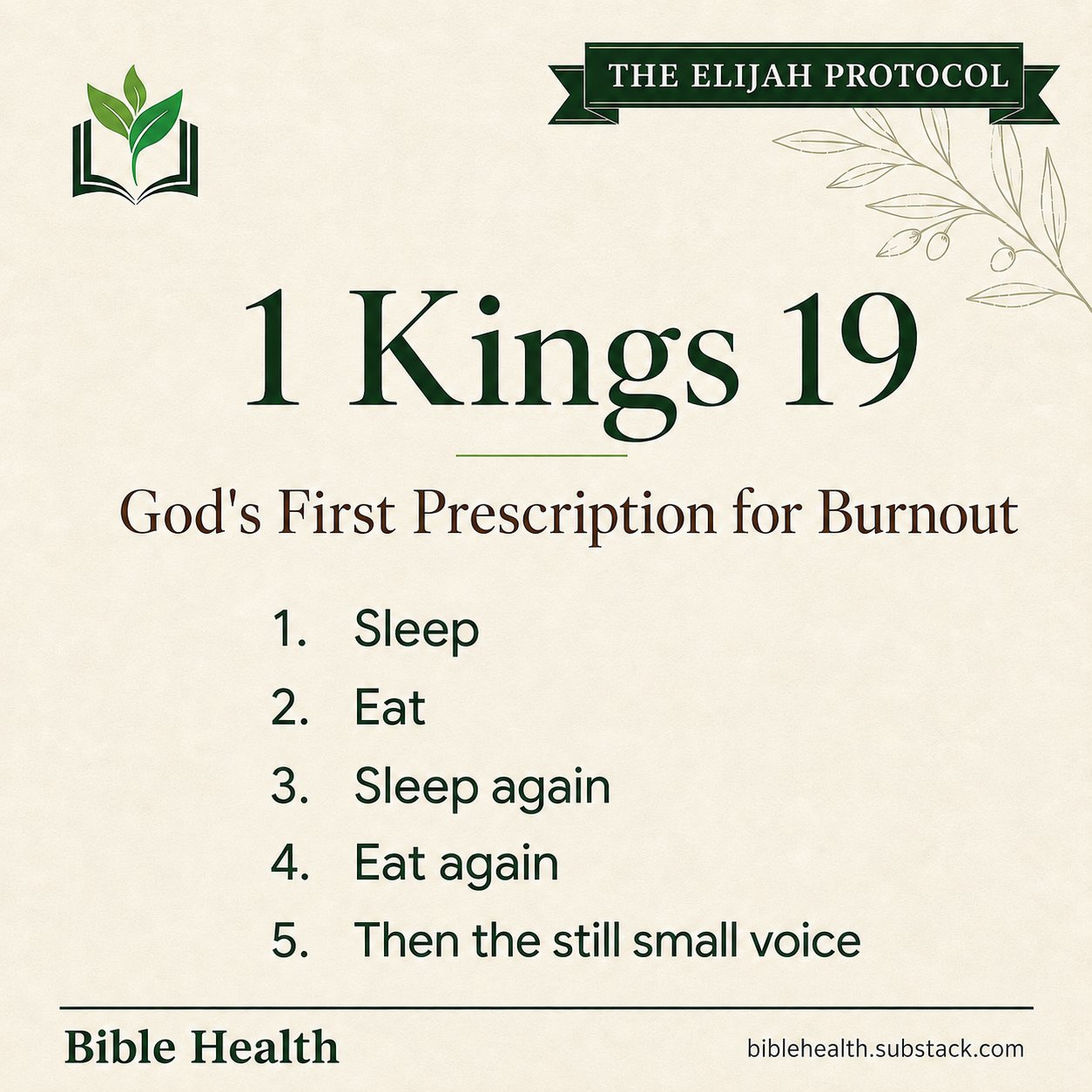
“And he lay down and slept under a broom tree. And behold, an angel touched him and said to him, ‘Arise and eat.’ And he looked, and behold, there was at his head a cake baked on hot stones and a jar of water. And he ate and drank and lay down again. And the angel of the LORD came again a second time and touched him and said, ‘Arise and eat, for the journey is too great for you.’” — 1 Kings 19:5–7
Notice what God did not do. He didn’t preach a sermon, didn’t quote Scripture at Elijah, didn’t tell him to pull himself together or remember whose he was.
God’s first response to a burned-out prophet was an angel, food, and sleep, followed by more food and more sleep before any words were spoken at all. The Bible’s most explicit prescription for a spiritual collapse is, almost literally, a nap and a snack.
If God thought Elijah needed to lie down before he could hear another word from heaven, the Christian mom reading this needs to know that her body is not lying when it asks for rest. Her body is repeating a message God wrote into the design of being human, where we sleep because He made us to, eat because He provides it, and need other people because He said it was not good for the man to be alone.
The need is not a weakness; it’s the architecture of being a creature.
“Thank you so much for everything you all do, and especially today for the Scriptures. I really needed those today.”
— Mary G.
The Sabbath was made for the Christian who’s tired
The fourth commandment was not given because God needed a day off. It was given because we do.
“Remember the Sabbath day, to keep it holy. Six days you shall labor, and do all your work, but the seventh day is a Sabbath to the LORD your God.” — Exodus 20:8–10
When the Pharisees came after Jesus for healing on the Sabbath, He gave them the explanation that pulls the whole thing into focus:
“And He said to them, ‘The Sabbath was made for man, not man for the Sabbath.’” — Mark 2:27
The Sabbath was a gift, not a burden. God built one day in seven into the calendar of the universe because He knew the body and the soul wear out.
He knew that without a hard stop, the work would never end. He knew that the human heart, left alone, would worship its own productivity until it broke.
So He named a day, blessed it, and commanded us to stop. The God who needs nothing modeled rest in Genesis 2 to teach His people how to live.
A research review across 1,338 effect sizes from 154 studies found that all forms of sleep loss reduced positive affect, increased anxiety symptoms, and blunted emotional arousal. Read that again.
Sleep deprivation is one of the most consistent predictors of emotional reactivity, irritability, and decision fatigue we have in the literature. The findings, published in Psychological Bulletin, echo what Scripture taught thousands of years ago: the body that doesn’t rest can’t love well.
And the mom who can’t love well is the mom every devil in the room has been hoping he could grind down.
If you’ve been waking up snapping at your kids and you can’t figure out why, the answer might be sitting on your bedside table at 11 PM, and the practice is as simple as putting the phone down earlier and going to bed.
Jesus modeled rest, and not just on the boat
We started with Mark 4:38 because the image is so vivid, but Jesus’s pattern of rest runs through the whole gospel.
“And rising very early in the morning, while it was still dark, He departed and went out to a desolate place, and there He prayed.” — Mark 1:35
“But He would withdraw to desolate places and pray.” — Luke 5:16
“And He said to them, ‘Come away by yourselves to a desolate place and rest a while.’ For many were coming and going, and they had no leisure even to eat.” — Mark 6:31
That last one is what Jesus said to the disciples. He saw they were exhausted, He saw they couldn’t even get a meal in, and He took them away.
He prioritized their rest over the crowds who needed Him. The Son of God, who had a finite window on earth and a world to redeem, chose rest for His people over more output.
That detail tells you everything about how God values the restored soul over the productive one.
If Jesus made time to withdraw, the Christian mom who feels guilty about taking an hour for herself is being asked to live by a higher standard than the Son of God modeled. That’s not godly.
That’s a lie satan told her, and the longer she believes it, the more her family suffers.
Paid Subscribers Only
Your Bible Health Swap This Week
#005: Refrigerator Makeover (from Mama Z’s Non-Toxic Kitchen Guide)
This week’s Swap includes Mama Z’s printable Refrigerator Makeover from her Non-Toxic Kitchen Guide!
One Swap this week. One faithful step. A transformed life.
Learn more about the Bible Health Transformation Journey and start wherever you are.
“It has truly been amazing for me and my family as we find natural and Biblical ways to improve our health and wellbeing in our home.”
— Wendy J.
