


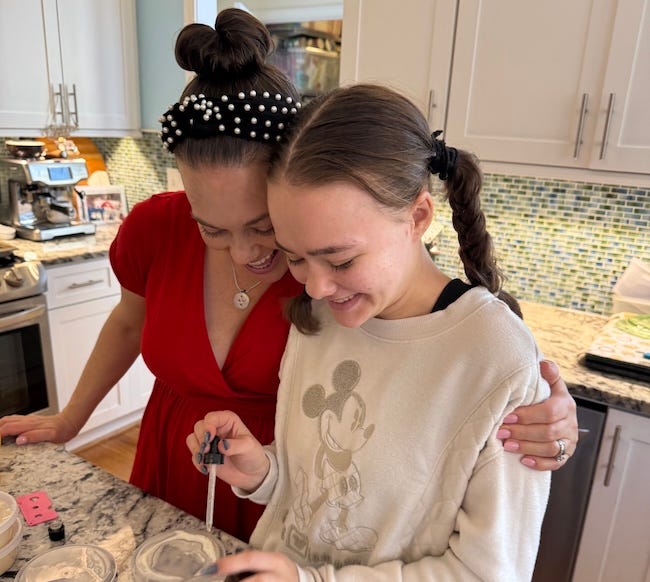
My eldest daughter Esther and I making homemade body butter in our kitchen. We’re writing this from Michigan, where we’re spending the week with my family as dementia keeps taking more of my father from us.
That’s a big part of why our kitchen looks like this today. We are trying our best to protect the next generation…
Mama Z here:
My dad, Nile, was recently diagnosed with Frontotemporal Dementia (FTD). This is the same condition that the actor Bruce Willis has, which was responsible for taking his ability to speak away from him.
It’s an ugly, rapidly developing disease.
In Dad’s case, sleep apnea has accelerated the condition. Whenever he doesn’t get enough oxygen at night, he is a completely different person the next day.
Forgetting things he just said, not knowing who you are, living in a daze. This has been heartbreaking for all of us, especially Mimi (my mom).
Just a couple years ago, Dad was sharp as a tack, a retired Ph.D. agro-scientist spending 40+ hours a week in the garden tending fruit trees, keeping up with his stocks and investments, a scratch golfer with one of the most brilliant memories you’d ever encounter. Now he looks at you with a blank stare, with sweetness in his eyes and a gentle smile, wondering who you are.
Words cannot describe what that does to you.
There is no explanation for why this happened to him other than Alzheimer’s and dementia run in his family. Being an agricultural scientist, though, he was exposed to a lot of chemicals in his work in the chemistry lab where he did extensive research and development.
This definitely could be a contributing factor, but that doesn’t make it any easier.
I’ve been traveling back and forth between Georgia and Michigan helping out as much as I can as my mom recovers from knee replacement surgery. And we have been spending our Spring Break in Michigan with all of the kids doing as much spring cleaning and yard work as we can to help lighten the load.
You don’t forget what dementia looks like when it’s sitting at your dinner table and the man you looked up to your entire life forgets your name.
Dr. Z chiming in here…
We definitely plan on sharing some light-hearted, fun stuff soon, but life hasn’t been light-hearted or fun lately for us. In fact, we’ve been dealing with one crisis after another, and our content is a reflection of what we are living.
But thanks be to God that we are more than conquerors in Christ Jesus, and we hope to encourage you with some of the strategies that we are learning about that are helping us thrive through the difficult seasons as we go through them with you. :)
In the meantime…
The Lie Christians Have Been Told About Their Kitchen
So when we tell you that the research on Alzheimer’s is pointing straight at the room where Christian families spend the most time, please hear us. Because here’s what nobody is saying from a pulpit: the more sanitized your kitchen, the higher your family’s risk of cognitive decline.
This isn’t a cleaning-product article. This is us, processing our reality out loud and begging you to look closer at yours before you’re sitting where we’re sitting.
A 2013 study published in Oxford’s Evolution, Medicine, and Public Health tracked Alzheimer’s rates across 192 countries. Differences in pathogen exposure, the study’s marker of hygiene, explained 33% of the variation between countries.
Not genetics. Not age.
Sanitation. The researchers called it an extension of the “hygiene hypothesis,” and the room where most of that chemical exposure happens every single day is the one where we prepare our food, wash our hands, and feed our children.
“It appears that hygiene is positively associated with [Alzheimer’s disease] risk. Countries with greater degree of sanitation and lower degree of pathogen prevalence have higher age-adjusted AD DALY rates.” — Fox et al., Evolution, Medicine, and Public Health (Oxford, 2013). 192 countries analyzed.
Scripture tells us to not be ignorant of the devil’s devices (2 Corinthians 2:11). Knowing what’s actually in the products your family uses every day is one of the most practical ways to apply that verse.
Honestly, if we had known twenty years ago what we know now, we would’ve started on day one.
This may not seem like a demonic attack. It looks like a cleaning aisle.
But the enemy is quietly ruining the health and minds of millions of Christian families through this one subtle deception, and most of them will never know what hit them until it’s too late.
The kitchen is the room where health is won or lost for most families. It’s where you prepare the food, wash the dishes, wipe the surfaces, store the leftovers, and gather around the table.
And for most Christian families, it’s also the room with the highest concentration of chemicals they never agreed to bring into their home.
You scrubbed the counters. You wiped down the stovetop.
You ran the dishwasher with the “eco-friendly” detergent you grabbed at the store last Tuesday because the label said “natural” and that felt like the right thing to do. Your kitchen smells clean.
Feels clean. Looks clean.
But that “clean” smell is a cocktail of synthetic chemicals that your lungs are absorbing right now, your skin is absorbing through your hands, and your kids are breathing in while they eat breakfast six inches from the counter you just wiped.
Your confusion about what’s safe and what isn’t? That confusion is someone else’s business model.
Let’s fix that together, because Mama Z’s dad didn’t get a warning, and we want you to have one.
Mama Z’s dad didn’t get a warning. Forward this to the Christian family who still can.
The Room That Runs Your Family’s Health
Think about how much time your family spends in the kitchen. Breakfast.
Lunch. Dinner.
Snacks. Coffee.
Water from the tap. Hands washed at the sink between meals and after school.
Dishes loaded and unloaded. Counters wiped.
Floors mopped.
The average American family spends more waking hours in or around the kitchen than any other room in the house. And every single one of those moments is a point of contact with whatever products you keep there.
We’re talking about dish soap, hand soap, all-purpose cleaner, glass cleaner, oven cleaner, disinfectant spray, dishwasher detergent, floor cleaner, sponges treated with antimicrobial chemicals, plastic wrap, food storage containers, non-stick cookware, and whatever is plugged into the outlet that makes the room “smell nice.”
That’s not a short list. And every item on it touches your family’s skin, lungs, food, or water supply multiple times a day.
A landmark 2018 study in Science tracked volatile organic compound (VOC) sources across major cities and found that chemical products, including cleaners, personal care products, and fragranced items, now contribute as much to urban VOC emissions as vehicle exhaust does. The researchers analyzed emission inventories from Los Angeles, and the results were staggering: the chemical products you bring into your home are now competing with cars and trucks as a source of the polluted air your family breathes!
The EPA’s own data confirms it: the air inside your home can be 2 to 5 times more polluted than the air outside, and in some cases more than 100 times higher.
Americans spend roughly 90% of their time indoors. And the kitchen, with its concentration of cleaning products, fragranced items, and heated surfaces, is the epicenter.
We’re not talking about living in a bubble. We’re talking about knowing what you’re actually using.
That’s all.
“My people are destroyed for lack of knowledge.” — Hosea 4:6
That verse isn’t metaphorical. It’s practical.
When you don’t know what’s in the bottle, you can’t make a real choice about whether it belongs in your home. And that lack of knowledge has a cost.
Not in 30 years. Right now.
“I’m grateful to be here, receiving encouragement, recipes, and whole-body transformation. Even after trying times, I trust you and Mama Z. The spiritual aspect completes the system: body, soul, and spirit.”
— Ellen D.
What’s Actually Under Your Sink
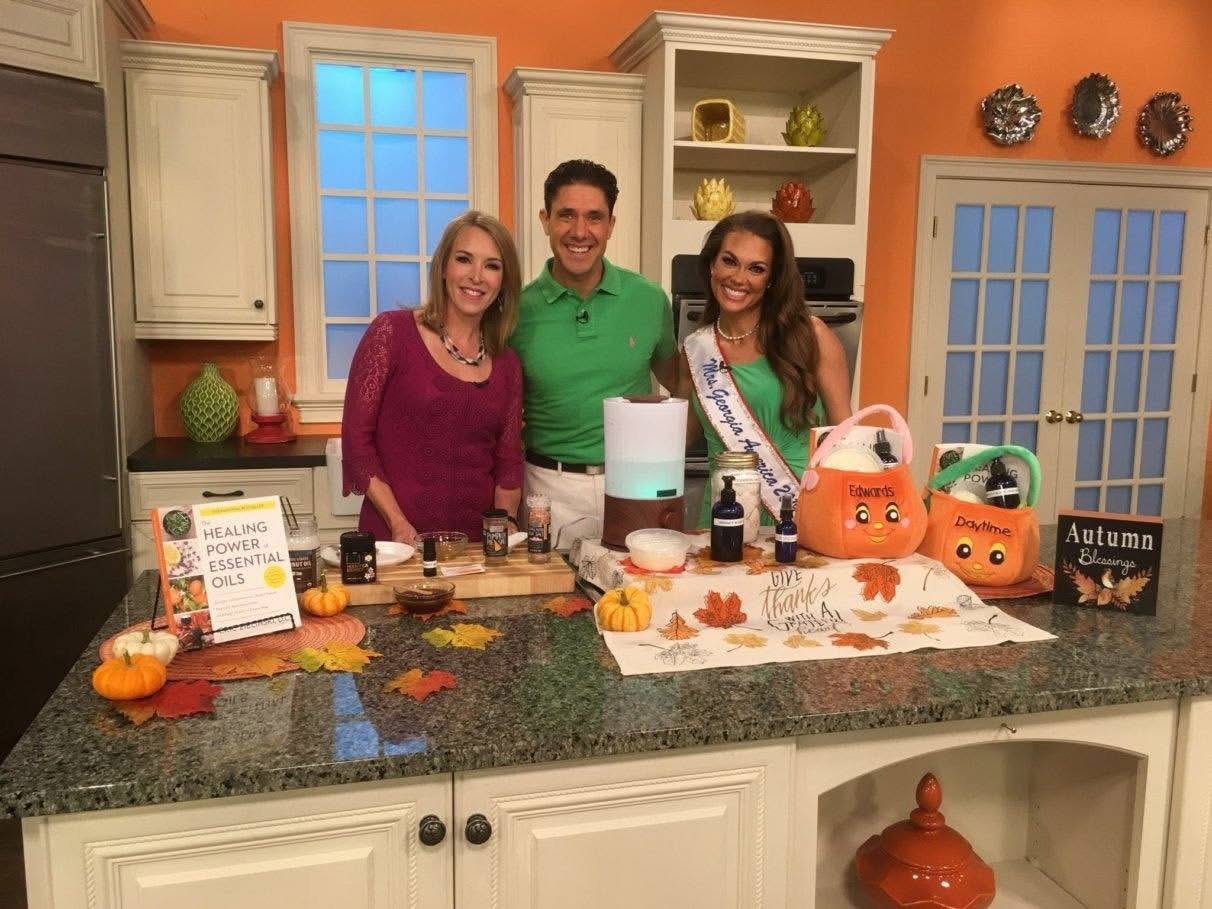
Flashback to 2018 during our first book tour. Here we are talking about DIY non-toxic kitchen essentials from The Healing Power of Essential Oils on Bloom TV in Tampa.
We want to walk you through something. It won’t take long.
Go to your kitchen sink right now, open the cabinet underneath, and pull out the first cleaning product you see. Flip it over.
Read the label.
If you’re like most people, you’ll find a wall of words that don’t look like anything you’d willingly bring near food.
Sodium lauryl sulfate, a surfactant that multiple peer-reviewed studies confirm disrupts the skin barrier and triggers inflammatory responses even at low concentrations.
Methylisothiazolinone, a preservative so allergenic that the American Contact Dermatitis Society named it “Contact Allergen of the Year” in 2013.
Fragrance, a single word that the Environmental Working Group reports can legally hide any combination of more than 3,000 undisclosed chemicals.
Quaternary ammonium compounds, documented in the medical literature as a cause of occupational asthma. Phthalates. Formaldehyde releasers.
You didn’t go shopping for formaldehyde releasers. But they’re there.
Formaldehyde is classified as a known human carcinogen by the National Toxicology Program. And formaldehyde-releasing preservatives are found in dish soaps, hand soaps, and disinfectant sprays sitting on store shelves right now.
They slowly release formaldehyde molecules over time, which your lungs absorb and your skin contacts with every use.
And here’s the part that will make you angry: under current federal regulations, companies are NOT required to disclose every ingredient on the label. The word “fragrance” alone is a legal umbrella, protected as a trade secret under the Fair Packaging and Labeling Act, that can cover hundreds of synthetic chemicals, many of which are classified as known or suspected endocrine disruptors, meaning they interfere with your hormones, and are linked to infertility.
Artificial fragrances are also obesogens: chemical compounds that promote weight gain and metabolic disruption.
Think about that for a second. The product you’re using to clean the surface where your kids eat breakfast is legally allowed to contain ingredients that mess with your hormones, your metabolism, and the company doesn’t have to tell you which ones!?
One of our readers, Mary, didn't change her diet. She didn't start a supplement.
She had no idea her dish soap could be the culprit. She felt empowered and started to make changes that made a real difference.
That’s the awareness that changes everything.
That’s not a miracle. That’s what happens when you remove something the body was reacting to.
A 2022 study published in the Journal of Allergy and Clinical Immunology found that residue from commercial dishwasher detergents and rinse aids left on “clean” dishes damages the gut epithelial barrier in a dose-dependent manner. The culprit: alcohol ethoxylates in the rinse aid.
The researchers found that these residues trigger inflammatory responses and break down the protective lining of the gut. You’re eating off those plates.
Think of your body like a bucket. Every day, things pour in: the food you eat, the air you breathe, the products that touch your skin, the chemicals that evaporate off your counters into the air.
When the bucket overflows, that overflow shows up as symptoms. Headaches.
Fatigue. Skin reactions.
Respiratory issues. Brain fog.
Joint pain. (We go deep on this in The Toxic Bucket, and it will change how you see every product in your home.)
For most families, the kitchen is filling that bucket faster than any other room in the house. And nobody told them.
“Thank you so much for everything you all do, and especially today for the Scriptures. I really needed those today.”
— Mary G.
The Three Things in Every Christian Kitchen That Don’t Belong There
We’ve been doing this for 23 years, and we’ve been in enough kitchens (literally and metaphorically) to know: there are three categories of products that show up in nearly every Christian household, and they’re the biggest contributors to the problem.
1. Conventional dish soap and hand soap.
You use these multiple times a day. Your hands are wet, your pores are open, and the skin absorbs what it touches.
Multiple studies published in peer-reviewed journals confirm that sodium lauryl sulfate, the primary surfactant in most conventional dish soaps, disrupts the skin barrier and triggers inflammatory responses in keratinocytes even at subtoxic concentrations. Most conventional dish soaps also contain synthetic fragrances and preservatives linked to skin irritation, hormone and metabolic disruption, and respiratory sensitivity.
You’re washing your family’s plates with it. Your kids are eating off those plates.
The residue doesn’t disappear. It transfers.
2. Conventional all-purpose cleaners and disinfectant sprays.
The “clean” smell you associate with a freshly wiped kitchen is almost always synthetic fragrance. Those VOCs (volatile organic compounds) don’t just sit on the counter.
They evaporate into the air. Your family breathes them in all day.
A 2018 study published in the American Journal of Respiratory and Critical Care Medicine followed 6,235 participants over 20 years and found that women who used chemical cleaning products regularly had lung function decline comparable to smoking 20 cigarettes a day. That’s not a typo.
Cleaning products. Comparable to cigarettes.
That’s worth repeating…
Women who used chemical cleaning products regularly had lung function decline comparable to smoking 20 cigarettes a day.
3. Artificial fragrance sources.
A large-scale population study found that over one third of Americans report adverse health effects from fragranced products, including respiratory difficulties and migraine headaches, and half of those affected said the effects could be disabling.
Artificial fragrances are one of our Three Non-Negotiables at Bible Health because the effects are immediate: headaches, sinus pressure, brain fog, sneezing, nausea. When our family went fragrance-free, the difference was overnight.
Not in a month. Overnight.
We don’t make a lot of guarantees, but we can promise you this. If you break up with your addiction to artificial fragrances, your life and health will change.
Not in months. Within days, often within hours.
Below is one of those statements the authorities want to stop you from hearing. It’s the kind of thing that will get us banned from social media (again).
But it’s a hill we’re willing to die on:
Artificial fragrances are one of the worst public health risks known to man. They’ve been linked to seasonal allergies, ADHD, autoimmunity, heart disease, stroke, cancer, metabolic dysfunction, obesity, and endocrine disruption, because they violate God’s sacred laws of nature.
Here’s our soapbox. God gave us natural plant-based fragrances.
We know them as essential oils. The synthetic knockoffs are unrecognizable to the human body, and they wreck every system you’ve got: immune, endocrine, lymphatic, neurological.
And they’re in everything. Literally everything with an aroma that isn’t pure essential oil.
Plug-in air fresheners. Scented trash bags.
Scented dish detergent. Soaps.
Cleaning sprays. Those little fragrance discs people toss in the dishwasher.
Dryer sheets that smell like “outdoor fresh.”
People are addicted to fragrance, and the manufacturers know it. That’s why everything has to smell like something.
Whatever happened to plain unscented bar soap?
We’ve been programmed to equate cleanliness with scent. But “clean” doesn’t have a smell.
Chemicals do.
“But test everything; hold fast what is good.” — 1 Thessalonians 5:21
Here’s the thing: nobody is testing these things. Most families trust the label, trust the brand, trust the “natural” claim on the front of the bottle, and never flip it over to read what’s actually inside.
That’s not a failure of character. It’s a failure of information.
And the companies selling these products are counting on it.
We’ve spoken at churches. We’ve sat in small groups.
We’ve listened to sermons on taking care of the body as a temple of the Holy Spirit. And we’ve never heard anyone, from the pulpit or the pew, say: “Hey, you might want to check what’s in your dish soap.”
It sounds trivial. It sounds like something a health nut would say.
And that’s exactly why it gets ignored.
But it’s not trivial when your kid has eczema that won’t clear up and nobody thinks to look at the detergent residue on their clothes and sheets. It’s not trivial when a mom is exhausted by 2 PM every day and nobody connects it to the synthetic air freshener running in every room of the house.
It’s not trivial when a dad has chronic headaches and the neurologist can’t find anything wrong.
The church talks about managing money well. Taking care of your time.
Investing in relationships. But the stewardship of the body God gave you?
That conversation barely happens. And when it does, it stops at “eat your vegetables” and never gets to “check what’s under your kitchen sink.”
“Do you not know that your body is a temple of the Holy Spirit within you, whom you have from God? You are not your own, for you were bought with a price. So glorify God in your body.” — 1 Corinthians 6:19-20
Glorifying God in your body starts with knowing what you’re putting in it and on it. That includes the food, yes.
But it also includes the cleaning products, the soaps, the sprays, and everything else you bring through your front door.
Paul wrote those words to the Corinthian church nearly 2,000 years ago, and modern research is catching up to what Scripture already declared: what enters your body matters. The peer-reviewed evidence on endocrine and metabolic disruption from phthalates, the lung function data from cleaning product exposure, the gut barrier damage from dishwasher residue: all of it confirms what God told us from the beginning.
Your body is not a dumping ground. It’s a temple.
Treat it like one.
This is not legalism. It’s not fear-mongering.
It’s faithful care of what God gave you. There’s a world of difference between “I have to change everything or God will be disappointed” and “I get to take care of this body God trusted me with.”
One is guilt. The other is worship.
One of our readers, Susanne, didn’t do it in a day. She didn’t spend a fortune.
She did it one product at a time, and each swap was simpler than the last.
The Question That Changes Everything
We’re not going to give you a full list of what to swap in this article. That’s not what this is for.
This is the article where you open your eyes, look around your kitchen, and ask one question:
“What am I actually using?”
Not what the label says. Not what the commercial promised.
Not what your mom used because her mom used it. What is actually in the bottle?
That one question is worth more than every product recommendation we could give you. Because once you start asking it, you can’t stop.
And once you can’t stop, the changes start happening on their own.
You’ll read the label on the hand soap. Then the dish detergent.
Then the laundry detergent. Then the shampoo.
Then the toothpaste. And with every label you read, you’ll realize how much you were trusting without verifying.
In our paid articles, we walk through exactly what to swap, one product at a time, with Mama Z’s DIY recipes that cost pennies and take minutes to make. One swap per week.
That’s the Bible Health Swap: 52 simple DIY projects every year that will drastically change how your family feels, sleeps, and heals in a year.
We’ve been where you are. Mama Z was on 10 medications in her twenties, dealing with food sensitivities so severe she could only eat four things.
We were on food stamps. We almost lost our marriage.
And a huge part of our healing started with the simplest question: what are we actually putting in and on our bodies?
The answer changed everything. Not because we found some magic product.
But because we stopped trusting products blindly and started making informed decisions based on actual ingredients, not marketing claims.
You don’t need a degree in chemistry to read a label. You just need permission to question what you’ve been told.
Consider this your permission. You’re not starting over.
You’re starting informed.
A Prayer for You. 🙏
Heavenly Father, thank You for the gift of family and for every memory You have woven into my life.
Give me strength, patience and tenderness as I care for the people I love in every season of their lives.
Give me wisdom to care for my own mind and body, so I can serve my family well for many years.
Thank You that I am never forgotten by You, and that Your love holds every generation.
Amen.
Upgrade and learn what God’s Word says about every area of life
and how to live it. That’s what Bible Health is all about.
Walk each 6-week live group study the day it opens.
Get the Blueprint and every weekly Swap.
Follow Jesus, not trends, in every area.
As always, our hope and prayer is that you experience the abundant life.
~ Dr. Z & Mama Z
References
https://academic.oup.com/emph/article/2013/1/173/1861845
https://www.science.org/doi/10.1126/science.aaq0524
https://pubmed.ncbi.nlm.nih.gov/29451393/
https://www.epa.gov/indoor-air-quality-iaq/introduction-indoor-air-quality
https://www.epa.gov/indoor-air-quality-iaq/volatile-organic-compounds-impact-indoor-air-quality
https://www.epa.gov/indoor-air-quality-iaq/inside-story-guide-indoor-air-quality
https://www.epa.gov/report-environment/indoor-air-quality
https://pubmed.ncbi.nlm.nih.gov/38917624/
https://pubmed.ncbi.nlm.nih.gov/30295372/
https://pmc.ncbi.nlm.nih.gov/articles/PMC4651417/
https://pubmed.ncbi.nlm.nih.gov/16283906/
https://pmc.ncbi.nlm.nih.gov/articles/PMC9163252/
https://pmc.ncbi.nlm.nih.gov/articles/PMC3404651/
https://pmc.ncbi.nlm.nih.gov/articles/PMC8157593/
https://www.ewg.org/news-insights/news/3163-ingredients-hide-behind-word-fragrance
https://pubmed.ncbi.nlm.nih.gov/33940212/
https://pmc.ncbi.nlm.nih.gov/articles/PMC10210541/
https://pubmed.ncbi.nlm.nih.gov/31603959/
https://pmc.ncbi.nlm.nih.gov/articles/PMC4689087/
https://pmc.ncbi.nlm.nih.gov/articles/PMC4197884/
https://pubmed.ncbi.nlm.nih.gov/36464527/
https://pmc.ncbi.nlm.nih.gov/articles/PMC6126357/
https://pmc.ncbi.nlm.nih.gov/articles/PMC5644973/
https://pmc.ncbi.nlm.nih.gov/articles/PMC4774862/
https://pmc.ncbi.nlm.nih.gov/articles/PMC5093181/
https://pubmed.ncbi.nlm.nih.gov/26354370/
https://pmc.ncbi.nlm.nih.gov/articles/PMC5773620/
https://pubmed.ncbi.nlm.nih.gov/36883522/
https://www.ncbi.nlm.nih.gov/books/NBK590839/
https://www.ewg.org/cleaners/content/cleaners_and_health/
https://pmc.ncbi.nlm.nih.gov/articles/PMC10051690/
Thank you for such an in depth article! I have recently learned this (past couple years) and have seen my health restored. Please keep sharing to help educate, and take back our health! Blessings 🤍🕊️
I just wanted to encourage you during this difficult time. We walked through the same thing with my Dad with Alzheimer's and dementia. While it hurts to see him decline and not remember you, that doesn't take away all the history you have with him. I also lived far away while he was going through this. During the last few years of my Dad's life, I also made the point to go and visit as much as possible to make sure that I was there for him. Did he not know who I was? Maybe. But that didn't matter. I was showing him the love and honor he deserved. That's what really mattered.
And God blessed us with a few moments here and there that will be with me forever. Dad smiling at my son while he showed him a photo album of his friends. Dad beaming at my daughter while she sang along with her choir recording. He couldn't talk or respond much, but he sure enjoyed that dedicated time with my kids.
I will forever remember the fact that my kids learned the Doxology, because my Mom sang it with my Dad every night before bed. Now every time it pops up in our lives, it reminds us of him, and I tell them that Grandpa taught them the Doxology.
I encourage you to find the joy amidst the difficulty and hold on to it. The hard times were hard, but it's these special times and more that will bring me joy for years and years to come.