



I don’t spend much time wondering what my boys will remember about me, but I think about what they’ll inherit from me every single day. Not just the foods we ate or the products we avoided, but whether they saw a man who loved Jesus, stewarded his body well, and lived with purpose.
Because Biblical Health isn’t about raising healthy kids, it’s about raising disciples who know how to walk with God long after we’re gone.
The Bible does not treat people like machines. Scripture never reduces us to calories, symptoms, lab markers, emotions, finances, or productivity.
We are whole people created in the image of God, and every part of life affects the others.
When one area suffers, the whole person feels it. Essentially, you’re only as strong as your weakest link which is why…
When your spiritual life is dry, your emotions suffer.
When your body is exhausted, your patience suffers.
When your mind is filled with confusion, your obedience suffers.
When your finances are in chaos, your marriage feels the pressure.
When your work has no purpose, your joy drains away.
When your relationships are shallow or broken, your health pays the price.
This is why Biblical Health must be bigger than food. It is a way of life—discipleship for the whole person.
It is learning to steward every area of life under the lordship of Christ.
And the anchor is this verse that changed our lives the first time we read it with open eyes and open hearts:
“The thief comes only to steal and kill and destroy. I came that they may have life and have it abundantly.” — John 10:10
The 7 Areas of Abundant Life
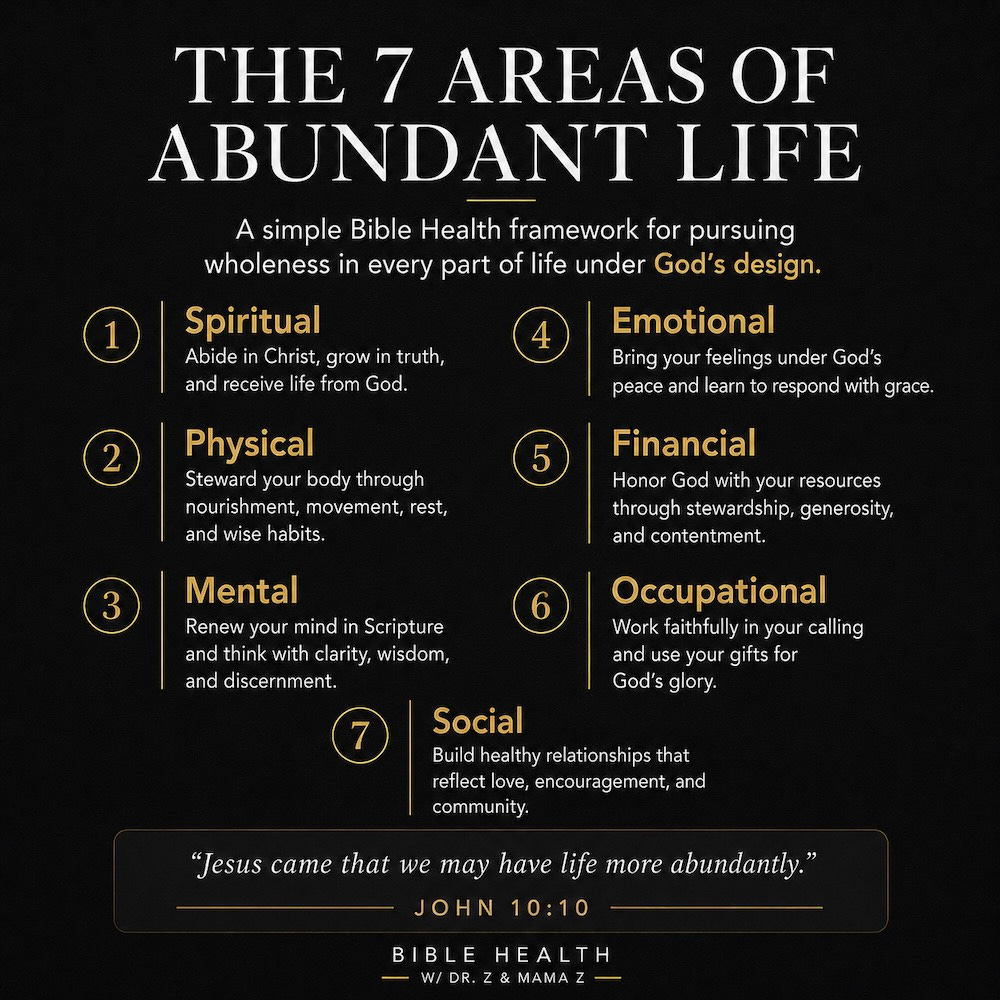
Biblical health is the abundant life Jesus described in John 10:10: a whole-person life where your spirit, body, mind, emotions, finances, work, and relationships are surrendered to God and moving toward balance.
This does not mean life is perfect, pain-free, or effortless. It means you are learning to steward every area of life as an act of worship, because every area is connected.
When one part suffers, the others feel it. When one part strengthens, the whole person benefits.
Here are the seven areas of Biblical Health, and their companion pieces with Biblical affirmations to help you take each area one step deeper.
1. Spiritual Abundance
Spiritual abundance is the foundation. Before we ask what is on the plate, we have to ask who is on the throne.
A Christian can eat the cleanest food in the world and still be spiritually malnourished. You can remove every toxin from your home and still be full of pride, fear, bitterness, lust, resentment, rebellion, or unbelief.
That is why the first question is not, “Is this food Biblical?”
The first question is, “Am I surrendered to God?”
Spiritual abundance means living in fellowship with the Father through Jesus Christ. It means prayer, worship, obedience, Scripture, repentance, humility, and the daily practice of seeking first the kingdom of God.
This is where health begins because this is where life begins.
Faith-based health trends often ask, “What did people eat in the Bible?”
Biblical Health asks, “Am I walking with the God of the Bible?”
That distinction changes everything.


2. Physical Abundance
Physical abundance matters because the body matters.
We reject the idea that the body is meaningless or merely temporary. Scripture says our bodies are temples of the Holy Spirit.
We are not our own. We were bought with a price.
Therefore, what we eat, drink, breathe, apply, and expose ourselves to matters.
This is where food, movement, sleep, sunlight, hydration, toxin reduction, natural remedies, and wise stewardship belong.
But physical abundance is not vanity.
It is not body obsession.
It is not fear based restriction.
It is not turning every meal into a moral performance.
Physical abundance is caring for the body so we can better worship, serve, work, disciple our children, love our spouses, think clearly, and fulfill our calling.
Yes, eat real food, avoid unnecessary toxins, move your body, sleep, and learn how God designed the body to heal, adapt, and thrive.
But never confuse physical stewardship with righteousness.
Food does not save you. Jesus does.
Go one step deeper…


3. Mental Abundance
Mental abundance is having the mind of Christ.
This is one of the most overlooked areas in the modern health conversation. Many people are physically disciplined but mentally captive.
They are constantly consuming fear, outrage, distraction, conspiracy, comparison, and confusion.
Their pantry is clean, but their mind is cluttered.
Their food is organic, but their thoughts are toxic.
Biblical Health requires renewing the mind. It requires wisdom, discernment, learning, focus, and the ability to take thoughts captive instead of being discipled by every headline, algorithm, influencer, and trend.
This is especially important right now because Christians are being discipled by health content at a staggering pace.
One creator says meat is the answer. Another says plants are the answer.
Another says raw milk is the answer. Another says supplements are the answer.
Another says the government is poisoning everything. Another says your doctor is lying.
Another says the latest shot, drug, cleanse, protocol, or ancient food is the missing key.
Mental abundance gives Christians the ability to discern without panic.
It teaches us to ask better questions.
Is this true?
Is this wise?
Is this fear based?
Is this Biblical?
Is this producing peace or obsession?
Is this helping me obey God or distracting me from Him?
Without mental abundance, health becomes another form of bondage.
Go one step deeper…


4. Emotional Abundance
Emotional abundance is not pretending everything is fine.
It is learning to live with the peace, joy, patience, self-control, and stability that come from walking with God.
This matters because many health problems are not only physical. Chronic stress, anger, fear, grief, unforgiveness, bitterness, trauma, and emotional exhaustion all affect the body.
You cannot live in constant fight or flight and call it abundant life.
Some Christians obsess over ingredients while ignoring the emotional atmosphere of the home.
But what good is a clean dinner if the table is filled with tension?
What good is homemade bread if the marriage is cold?
What good is avoiding artificial fragrance if the children are breathing in constant anger, criticism, and fear?
Emotional abundance means letting the Holy Spirit govern the inner life.
It means guarding the heart, learning to forgive, speaking life, practicing gratitude, and refusing to let anxiety become the family culture.
This is not soft. This is discipleship.
A peaceful home is part of Biblical Health.
Go one step deeper…


5. Financial Abundance
Financial abundance is not prosperity gospel greed.
It is not chasing wealth, or measuring God’s favor by income.
Biblical financial abundance means having needs met, refusing bondage to debt, practicing contentment, stewarding resources wisely, and living with enough margin to give generously.
This belongs in the health conversation because financial chaos affects the whole person.
Bad debt creates pressure.
Pressure affects sleep.
Poor sleep affects hormones.
Hormonal stress affects appetite.
Appetite affects food choices.
Food choices affect health.
Health affects work.
Work affects income.
Income affects the home.
Everything is connected.
A Christian family can buy organic groceries and still be financially unhealthy if the lifestyle is built on debt, comparison, impulse spending, and lack of stewardship.
Biblical Health teaches us to ask:
Are we living within our means?
Are we giving?
Are we saving?
Are we wasting?
Are we trying to look abundant while actually living in bondage?
God cares about our finances because He cares about our freedom, generosity, peace, and obedience.
Go one step deeper…


6. Occupational Abundance
Occupational abundance is finding purpose in the work of your hands.
This does not mean every job feels easy. Work became difficult after the fall, and many people go through hard seasons where faithfulness matters more than fulfillment.
But work still matters to God.
Before sin entered the world, Adam had work to do. Work is not a curse.
Meaningless, oppressive, exhausting, misaligned work is part of the brokenness sin introduced.
Many Christians are physically sick because they are living under chronic occupational stress. They hate their work.
They feel trapped. They have no purpose.
They are overcommitted, under-rested, constantly available, and spiritually drained.
No diet can fully compensate for a life that violates God’s design. No supplement can replace calling.
No detox can heal a person who refuses to ask whether their work fits their gifts, family priorities, convictions, and season of life.
Occupational abundance asks:
Am I honoring God in my work?
Am I using the gifts He gave me?
Am I sacrificing my family on the altar of success?
Am I working from calling or fear?
Am I making room for Sabbath, worship, service, and rest?
Biblical Health is not just what you eat.
It is how you live.
Go one step deeper…


7. Social Abundance
Social abundance is the health of your relationships.
And this may be one of the biggest blind spots of faith-based health trends.
God said:
“It is not good that the man should be alone.” — Genesis 2:18
That was before the fall.
Loneliness was not part of God’s design. Isolation is not a health strategy.
Digital followers are not the same as covenant relationships. Comment sections are not fellowship.
Online agreement is not community.
You can have the perfect ancestral diet and still be relationally starving. You can avoid processed food and still live disconnected from your spouse.
You can homeschool, homestead, garden, ferment, bake, and avoid toxins while still lacking deep friendship, church accountability, and multigenerational support.
Social abundance means building relationships that are truthful, faithful, forgiving, present, and mutually strengthening.
It means marriage matters.
Children matter.
Church matters.
Friendship matters.
Hospitality matters.
Elders matter.
Serving widows and orphans matters.
Sitting at a table with real people matters.
The early church did not merely share theology. They shared meals, homes, resources, burdens, prayers, and daily life.
That is Biblical Health, not isolated purity, but shared fellowship.
Go one step deeper…


“I’m grateful to be here, receiving encouragement, recipes, and whole-body transformation. Even after trying times, I trust you and Mama Z. The spiritual aspect completes the system: body, soul, and spirit.”
— Ellen D.
The John 10:10 Abundant Life
This is why limiting faith-focused wellness to eating and exercise is too small.
It may ask a useful question about food, but it cannot carry the full weight of Christian discipleship.
The Bible does speak to food and exercise.
But it also speaks to the soul, the mind, the emotions, money, work, marriage, friendship, generosity, rest, worship, and the condition of the heart.
When health becomes only physical, we miss the point.
When food becomes righteousness, we create legalism.
When Scripture becomes marketing, we create grift.
When wellness becomes fear, we create bondage.
When clean living becomes identity, we create pride.
But when the whole person is surrendered to Jesus, health becomes worship.
That is the invitation.
Not a trend.
Not a diet.
Not a purity contest.
Not a supplement funnel with Bible verses sprinkled on top.
Biblical Health is discipleship for the whole person. It is learning to steward every area of life under the lordship of Christ.
Biblical Health is abundance in the 7 key areas of your life:
Spiritual abundance.
Physical abundance.
Mental abundance.
Emotional abundance.
Financial abundance.
Occupational abundance.
Social abundance.
And all of it points back to the words of Jesus:
“The thief comes only to steal and kill and destroy. I came that they may have life and have it abundantly.” — John 10:10
That is the conversation Christians need to recover.
Not merely, “What should I eat?” But, “Lord, what does it look like for my whole life to belong to You?”
These Bible Health tips are too good not to share. :)
Not Legalism: The Difference Between Faithful Care and Self-Righteousness
Let us name the fear most Christians carry when this conversation starts, because if we do not name it, it quietly shuts the whole thing down. The fear is that caring for the body is vanity, or worldliness, or a distraction from what really matters.
Paul dealt with this in 1 Timothy 4:8, and he did not throw out the body to solve it.
“For while bodily training is of some value, godliness is of value in every way, as it holds promise for the present life and also for the life to come.” — 1 Timothy 4:8
He did not say bodily training has no value. He said godliness has value in every way, including in this life, right now, in the body you are living in today.
Faithful care of the body is not righteousness—it is the response of a grateful steward.
“Or do you not know that your body is a temple of the Holy Spirit within you, whom you have from God? You are not your own, for you were bought with a price. So glorify God in your body.” — 1 Corinthians 6:19-20
The difference between legalism and discipleship is the direction you are facing when you make the choice. Legalism faces the mirror.
Discipleship faces the Father. This is the same path we teach through the Seven R’s framework, Repent, Renew, Remove, Replenish, Rest, Restore, Revive, which we unpacked in The Health Framework Your Pastor Never Taught You.
A lot of this lands first in the bathroom cabinet, which is why Mama Z’s non-toxic body care swaps are one of the most practical entry points we know.
“Present your bodies as a living sacrifice, holy and acceptable to God, which is your spiritual worship. Do not be conformed to this world, but be transformed by the renewal of your mind.” — Romans 12:1-2
That verse is not about food, and it’s not about supplements. It is about the entire physical life brought under the Lordship of Christ.
“Thank you so much for everything you all do, and especially today for the Scriptures. I really needed those today.”
— Mary G.
The Invitation
So here is what we are asking.
Join this.
Not our lifestyle, not our particular way of eating, not a brand. Join God’s way of thinking about the body He gave you.
If this stirred something in your spirit, that is the Holy Spirit confirming what you already knew, and if you want to start your week in the Word with us and make positive changes in your life, this Bible Health Transformation Journey is a good place to begin.
Subscribe free, and we will keep showing up in your inbox every week with Scripture-first teaching that helps your family feel better, God’s way.
A Prayer for You. 🙏
Father God, thank You that Jesus came so I may have life and have it abundantly.
Bless every area of my life: my spirit, my body, my mind, my emotions, my finances, my work and my relationships.
Show me the next faithful step in the area that needs it most, and give me the strength to take it.
Let my whole life be a testimony of Your goodness to my family and everyone around me.
Amen.
Upgrade and learn what God’s Word says about every area of life
and how to live it. That’s what Bible Health is all about.
Walk each 6-week live group study the day it opens.
Get the Blueprint and every weekly Swap.
Follow Jesus, not trends, in every area.
As always, our hope and prayer is that you experience the abundant life.
~ Dr. Z & Mama Z
References
• Keshani et al. Mediterranean Diet Reduces Inflammation in Adults: A Systematic Review and Meta-Analysis of Randomized Controlled Trials.
Nutrition Reviews (2025). https://pubmed.ncbi.nlm.nih.gov/41211687/
• Lane et al. Ultra-Processed Food Exposure and Adverse Health Outcomes: Umbrella Review of Epidemiological Meta-Analyses.
BMJ (2024). https://pubmed.ncbi.nlm.nih.gov/38418082/
• Association Between Higher Ultra-Processed Food Consumption and Risk of Diabetes: Meta-Analysis (2025). PubMed. https://pubmed.ncbi.nlm.nih.gov/39848440/
• Do Synthetic Fragrances in Personal Care and Household Products Impact Indoor Air Quality and Pose Health Risks? (Radis-Baptista, 2023).
Journal of Xenobiotics. https://pubmed.ncbi.nlm.nih.gov/37092508/
• Impact of Perfumes and Cosmetic Products on Human Health: Narrative Review. PMC (2025). https://pmc.ncbi.nlm.nih.gov/articles/PMC12425936/
• Phthalates and Female Reproductive Health: Literature Review (Basso et al., 2022). PubMed. https://pubmed.ncbi.nlm.nih.gov/35248714/
• Barna Group. Pastoral Well-Being Research, 2015 to 2023. https://www.barna.com/research/pastors-well-being/
• Christianity Today. No Guardrails for Some Christian Wellness Influencers (March 2026).
• Biblical Eating Trend Coverage (New York Times, May 2026).
• Why Christians Are As Sick As Everyone Else (Bible Health).
• The Health Framework Your Pastor Never Taught You (Bible Health).