


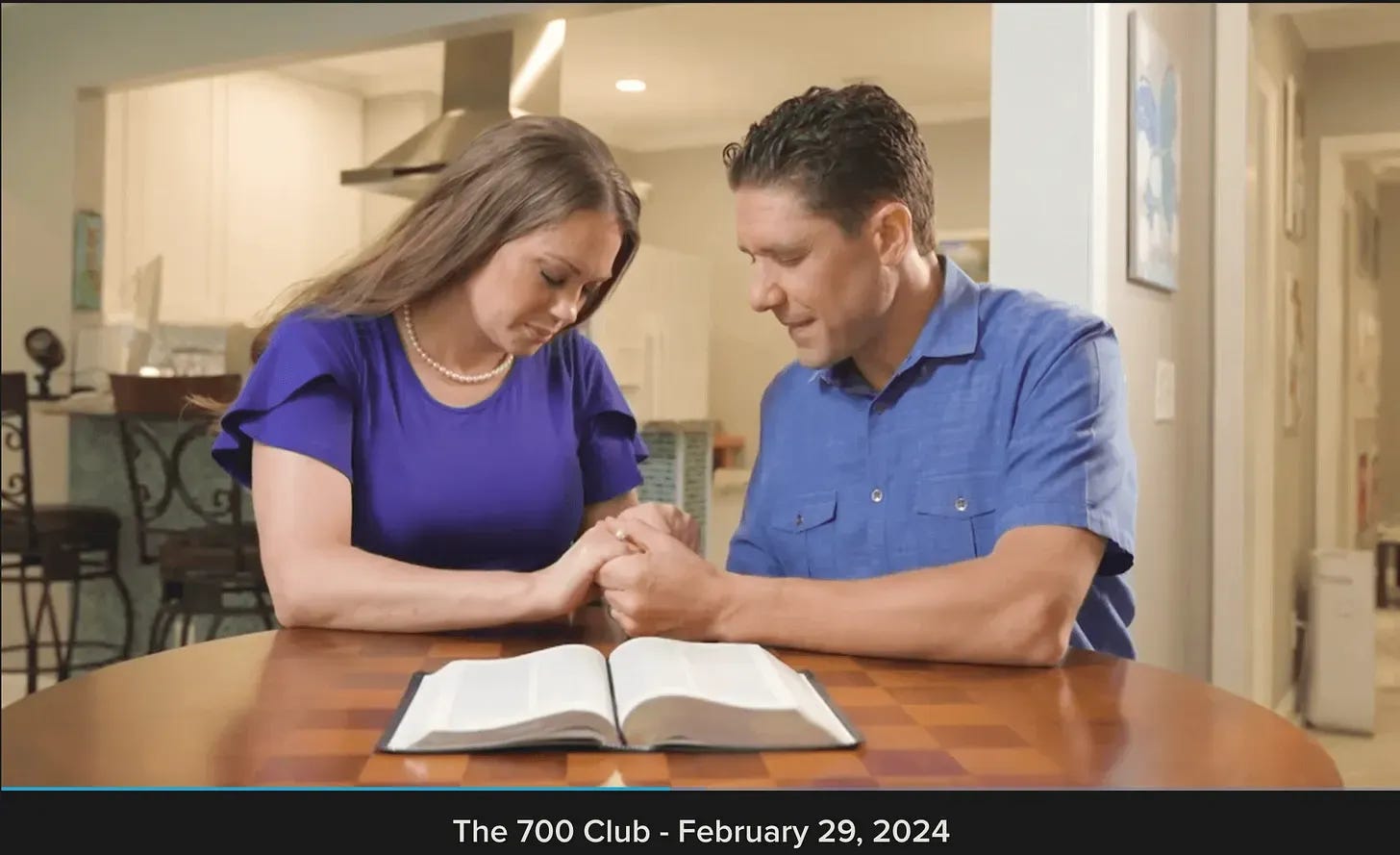
Circa 2024, when CBN spent two days at our home filming their Immune Boosting Docu-Series for the 700 Club. When they asked us to stop and pray on camera, we did not have to reach for something we did not have.
This is how we actually live. The holy pause you are reading about is something we practice every week as a family of nine.
You can watch the 700 Club Segment here. (Skip to 16:07)
Recently, one of our children asked us a question that stopped the whole room.
“Why are we always so busy?”
Nobody answered for a few seconds.
Because the truth is, we love God, we read Scripture, we eat clean, we pray together. And sometimes we still live like Pharaoh is our master instead of Jesus.
If you are reading this in a season where you are doing everything right and the tank still never feels quite full, stay with us. Because the piece most people skip is the one God commanded from the very beginning, and the one Jesus personally extended as an invitation.
“Come to Me, all who labor and are heavy laden, and I will give you rest. Take My yoke upon you, and learn from Me, for I am gentle and lowly in heart, and you will find rest for your souls. For My yoke is easy, and My burden is light.” — Matthew 11:28-30
No, we’re not going to tell you to take a nap today, even though that may help (we already wrote about that here).

We have something deeper to talk about.
Today we need to talk about the rest piece where sincere, hardworking Christian men and women quietly fall apart. We have been those people, both of us, just from different directions and in different seasons.
Between the two of us, we had cleaned up the pantry, rebuilt the kitchen from scratch, were reading the Word every morning, building a ministry, raising a family, and launching a platform. From the outside it looked like momentum.
From the inside, it felt like running with the tank on empty, pouring out more than we were ever taking in, and calling it faithfulness because we did not have another word for it.
We kept telling ourselves rest was something we would earn once the work was finally finished.
It never was.
Every milestone moved the finish line further out. And our bodies paid for it in ways we did not fully recognize until we both, in different seasons and in very different ways, finally stopped.
Quick Answer: What Is a Holy Pause?
A holy pause is an intentional stop built around God’s design for rest. It may be a Sabbath day, a protected evening, a quiet walk, a bath before bed, or twenty minutes without a phone, but the heart is the same: you are teaching your body and soul that God is your Provider, not your productivity.
A holy pause is not laziness. It is not escape. It is not self-indulgence.
It is obedience.
It is trust.
It is a small act of surrender that says, “Lord, You are God, and I am not.”
Research now confirms what Scripture has taught from the beginning. Chronic stress can affect cortisol, blood sugar regulation, inflammation, immune function, sleep quality, mood, and metabolic health. Rest is not weakness. It is part of how God designed the body to repair.
You Cannot Out-Supplement a Nervous System That Never Rests
“And on the seventh day God finished His work that He had done, and He rested on the seventh day from all His work that He had done. So God blessed the seventh day and made it holy, because on it God rested from all His work that He had done in creation.” — Genesis 2:2-3
Rest is not a concession to human weakness.
God built it into the structure of creation before sin entered the world, before sickness, before striving, before there was anything to recover from.
He rested on the seventh day not because He was tired, but because He was modeling a pattern the whole created order would need.
What God calls holy, we often call optional.
We will overhaul the pantry, research every label, avoid fragrance, drive across town for better food, and spend hundreds of dollars on supplements, but then run ourselves into the ground and wonder why the symptoms will not fully lift.
Here is what may be happening underneath.
When your body is chronically stressed, it reads your life as a threat and responds accordingly. The hypothalamic-pituitary-adrenal axis, often called the HPA axis, helps regulate the stress response.
Cortisol, one of the body’s primary stress hormones, influences metabolism, immune activity, cardiovascular tone, blood sugar availability, and inflammation.
That is not bad. God designed the stress response for survival.
The problem is when the alarm never turns off.
Chronic stress has been linked in research to disrupted glucose regulation, insulin resistance, immune dysregulation, increased inflammation, and changes in sleep and metabolism. Sleep disturbance has also been associated with higher markers of systemic inflammation.
Poor sleep can affect immune function, mood, cognition, appetite, and metabolic health.
In plain English:
Cortisol and adrenaline may stay elevated.
Inflammation can rise.
Blood sugar can become harder to regulate.
Sleep becomes lighter and less restorative.
Cravings can increase.
Patience gets thinner.
Your body may hold onto fat more stubbornly because it does not feel safe enough to release.
None of that is a moral failure.
It is physiology, but it is also discipleship. Because a body that never stops eventually starts telling the truth your schedule refuses to admit.
You cannot pray your way around God’s design. You cannot supplement your way around chronic striving.
You cannot biohack a nervous system that never receives the signal that the threat is over.
What your body actually needs is the very thing God built into the week from the beginning: a regular, protected stop.
“Remember the Sabbath day, to keep it holy. Six days you shall labor, and do all your work, but the seventh day is a Sabbath to the Lord your God. On it you shall not do any work.” — Exodus 20:8-10
Nine of the Ten Commandments get regular airtime in Christian circles.
We preach on coveting.
We preach on honoring parents.
We preach on keeping His name holy.
But this one, the one where God literally commands us to stop, is often treated like a suggestion for people with less demanding lives.
The Sabbath was not a cultural accommodation for ancient Israel. It was the same rest God modeled in creation, now given to His people as a boundary and a gift.
Israel had spent generations in Egypt, where their value was measured by bricks, quotas, and production. Sabbath was God declaring, “You are not slaves anymore.”
That is still the word many of us need.
You are not a slave to your inbox.
You are not a slave to your calendar.
You are not a slave to your business.
You are not a slave to your children’s activities.
You are not a slave to your phone.
And you are certainly not a slave to the constant pressure to prove you are faithful by staying exhausted.
Since 2014, we have been equipping Christian families to navigate today’s toxic world with Biblical wisdom and practical health solutions. Upgrade to paid and join a growing community committed to honoring God with every area of life, one faithful step at a time.
What We Watched Happen in Our Own Lives
Mama Z was on ten medications in her twenties. She had IBS, an eating disorder, and could only tolerate four foods.
She was doing everything she knew to do, and her body was still falling apart.
What nobody told her was that the stress of managing all of it, the fear, the restriction, the relentless striving to be well, was feeding the very fire she was trying to put out.
The physical and the spiritual were pulling in opposite directions, and a body cannot heal well in that tension.
Until surrender replaced striving, healing could not fully take hold.
The diet changes mattered.
The clean swaps mattered.
The essential oils mattered.
The supplements had their place.
But they did not do their full work until her nervous system finally received the signal that the threat was over.
Rest was not the reward at the end of her healing.
It was one of the conditions for it.
The God who took Mama Z from ten medications and four foods to a full, active life, the same woman who would later compete and win Mrs. Georgia, did not do any of it in a weekend. And He did not do it through striving.
He did it the same way He has always worked: through surrender, through trust, and through the grace to finally stop fighting and let Him carry what we were never meant to carry alone.
That is exactly what Jesus was describing in Matthew 11. He was not merely offering relief from fatigue.
He was offering an entirely different way of living, a yoke that fits instead of one that grinds you down.
Read Mama Z’s full story here:

God’s Design and Modern Science Agree
This is where Bible Health is so different from trend-driven wellness.
We do not start with the research and then try to force Scripture to agree with it.
We start with God’s Word, and then we are not surprised when the body He designed works the way He said it would.
Modern research continues to show that stress, sleep, immune function, inflammation, metabolism, and emotional health are deeply connected.
Stress affects the HPA axis, the body’s central stress-response system.
Cortisol influences blood sugar availability, metabolism, immune regulation, and inflammatory signaling.
Sleep disturbance is associated with increased inflammation and chronic disease risk.
Stress, sleep, and metabolism interact through hormonal, nervous-system, and inflammatory pathways.
Research on Sabbath-keeping among Christian school teachers has also found an inverse relationship between Sabbath observance and burnout, suggesting that regular sacred rest may be practically protective as well as spiritually meaningful.
That does not mean Sabbath is a medical treatment.
It means God’s commands are not random.
They are wise, protective, and life-giving.
“Blessed is the man who trusts in the LORD, whose trust is the LORD.” — Jeremiah 17:7
Signs You May Need a Holy Pause
You may need a holy pause if:
You wake up tired even after a full night in bed.
You feel guilty sitting still.
You snap at your family over small things.
You keep researching health answers but never feel at peace.
You pray, but your mind keeps racing.
You eat clean but still feel inflamed, depleted, or stuck.
You cannot remember the last time you had an unhurried conversation.
You reach for your phone the moment there is silence.
You treat Sunday like a catch-up day instead of a set-apart day.
You are doing good things, but your soul feels thin.
If that is you, do not hear condemnation.
Hear invitation. Jesus did not say, “Come to Me once you have earned it.”
He said, “Come to Me.”
“I’m grateful to be here, receiving encouragement, recipes, and whole-body transformation. Even after trying times, I trust you and Mama Z. The spiritual aspect completes the system: body, soul, and spirit.”
— Ellen D.
The Small Practice That Changes Everything
For most families, a true Sabbath day takes time to build toward.
We are raising seven children. We know what a packed week looks like from the inside.
A full twenty-four-hour stop can seem unreachable in some seasons.
If that is where you are right now, start smaller.
A protected evening.
A fifteen-minute walk with no phone.
A warm bath before bed.
A quiet morning before the house wakes up.
A family meal where no one rushes off.
These are not luxuries. They are rehearsals for obedience, and they are small acts of trust that tell your nervous system the alarm can come down.
A Sabbath is not a reward you earn after the work is finally finished. It is the boundary that keeps the work from consuming you.
Epsom salts.
A couple drops of lavender.
Twenty minutes of genuine stillness.
No phone.
No task list.
Climb into bed within the hour.
Watch how differently you sleep, how much more patient you are with your kids in the morning, and how much more present you are with your spouse.
That is not vanity.
That is caring for the body God gave you to carry His calling.
Five Ways to Practice a Holy Pause
If Sabbath feels impossible, do not quit before you start.
Start with the smallest faithful version.
1. Start With Five Minutes
Sit quietly. Breathe.
Pray one verse. Put your phone away.
Let your body feel stillness without trying to fix anything.
Try this:
“Lord, teach me to stop striving and receive Your rest.”
“Thank you so much for everything you all do, and especially today for the Scriptures. I really needed those today.”
— Mary G.
2. Take Twenty Minutes
Take a walk, soak in a bath, sit outside, stretch, or read Scripture slowly.
No multitasking.
No scrolling.
No tweaking.
Just presence.
3. Protect One Evening
Choose one evening this week without errands, work, screens, and catch-up tasks.
Eat simply.
Pray together.
Go to bed earlier.
The house can be imperfect.
The dishes can wait.
Let your family feel what peace sounds like.
4. Set Apart Half a Day
Choose a block of time where the family stops buying, working, striving, and producing.
Worship.
Eat.
Rest.
Walk.
Talk.
Read.
Delight in God’s gifts.
5. Build Toward One Sabbath
Build toward a weekly routine where one day is set apart to the Lord.
Not as legalism, or as performance. But as trust.
Because the goal is not to prove how holy you are. The goal is to remember who holds your life together.
A Prayer for You. 🙏
Heavenly Father, thank You for inviting me to come to You and find rest for my soul.
Teach me to pause throughout my day, to breathe, to be still and to remember that You are God.
Help me honor the gift of rest You built into creation, and give me peace in the quiet moments I spend with You.
Let me trust You fully, like a tree planted by water, so I can face every day with calm and confidence.
Amen.
Upgrade and learn what God’s Word says about every area of life
and how to live it. That’s what Bible Health is all about.
Walk each 6-week live group study the day it opens.
Get the Blueprint and every weekly Swap.
Follow Jesus, not trends, in every area.
As always, our hope and prayer is that you experience the abundant life.
~ Dr. Z & Mama Z
References
CBN / 700 Club Immune Boosting Segment (skip to 16:07)
Thau L, Gandhi J, Sharma S. Physiology, Cortisol. StatPearls.
NCBI Bookshelf.
Herman JP, McKlveen JM, Ghosal S, et al. Regulation of the Hypothalamic-Pituitary-Adrenocortical Stress Response.
Comprehensive Physiology. 2016.
Irwin MR, Olmstead R, Carroll JE. Sleep Disturbance, Sleep Duration, and Inflammation: A Systematic Review and Meta-Analysis.
Biological Psychiatry. 2016.
Hirotsu C, Tufik S, Andersen ML. Interactions Between Sleep, Stress, and Metabolism.
Sleep Science. 2015.
Cheng A, et al. A Cross-Sectional Analysis of the Relationship Between Sabbath Practices and US, Canadian, Indonesian, and Paraguayan Teachers' Burnout.
Journal of Religion and Health. 2022.
What I truly love about your articles are how well thought out they are. You explain things in detail which helps me understand the "why's" of it. I can be told to rest because it's good for me, but that doesn't really "stick" in my mind. But when you explain, in detail, why it matters and how God designed it all to work and what I need to do, not all at once, which leads to failure, but one baby-step at a time which is doable, I know I can do this and why I need to. Thank you!
The timeliness of this post for me can’t be overstated. I was recently diagnosed with a life threatening autoimmune disorder, which is causing me to rethink my priorities in life. I am not able to do much now except rest, which is allowing me to focus on the things that really matter. I truly believe that God has given me this “holy pause” to do just this. It wasn’t easy at first, but I am grateful for this gift. Thank you for putting this into words so well for me, and for being so transparent about your own journeys. You are greatly appreciated! God bless you and your beautiful family! ❤️