


With my eldest daughter, Esther, right before her prom, I was reminded how much love is poured into the little things: the dress, the photos, the prayers, and the home our children are sent out from. Especially when I’ve done my best to make sure that home was as healthy as it could be.
That is why this conversation matters so much, because for 50 years Christian mothers were taught that “fragrance” meant clean, feminine, and cared for, when that one word can hide chemicals our families breathe every day. This article is not about fear, but wisdom, stewardship, and learning how to make our homes heal instead of harm.
I hope you find it helpful…
The Smell You Were Taught to Trust
This is the fragrance manifesto we’ve been preaching for 15 years. We’ve shared it in our 3 Penguin Random House books about essential oils, in dozens of documentaries, podcasts, radio and TV shows around the world.
People think we’re extreme until they get sick, and then they come to us. It always goes back to the basics:
What are you eating? What are you drinking?
What are you breathing all day?
If you don’t clean those up, you can never really expect to feel well, and it’s this third one that most people neglect to consider.
You light the candle, you spray the counter, you pull the warm laundry out of the dryer, and your home finally smells the way a Christian home is supposed to smell, which is clean and cared for and safe. And somewhere in that same house there is a headache that shows up most afternoons, a child whose nose is always a little stuffed, and a tiredness that sleep never quite seems to fix, and not once has anyone told you that those two things might be connected.
They are connected more often than you would believe. The smell you have trusted your whole life as the proof of a well-kept home is, for millions of families, one of the most concentrated sources of hormone-disrupting chemicals they breathe all day long.
We are not saying this to scare you, because fear has never healed anyone, and that is not how we teach. We are saying it because it is true, and because the truth is the only thing that ever set anybody free.
For about fifty years now, the message sold to mothers has been that a fragranced home is a loved home, that the perfume makes you put-together, that the plug-in means you are taking good care of your space, and almost none of us stopped to test whether the thing we were trusting was telling us the truth.
“There is a way that seems right to a man, but its end is the way to death.” — Proverbs 14:12
That verse is not only about big, dramatic sin. It is also about the small, respectable, normal-looking choices that seem right precisely because everybody around us is making the same ones.
Artificial fragrance is the third of the Three Non-Negotiables we teach, right alongside reducing white processed sugar as much as possible and cutting out inflammatory foods, and it is the one almost nobody wants to talk about, because it feels so harmless and so woven into the way we show love at home.
New to Bible Health?
Welcome, we are so glad you found us. This is where we help families feel better today by trusting the way God made the body and clearing out what gets in its way, with no fear and no shame. Fragrance is one piece of a much bigger picture, so if you are just finding us, start with The Toxic Bucket, where we show how a thousand small exposures keep filling the same bucket until the body finally overflows, and then The Three Non-Negotiables, where artificial fragrance is number three on the list. Then come right back to this one.
The One Word on the Label That Is Allowed to Lie
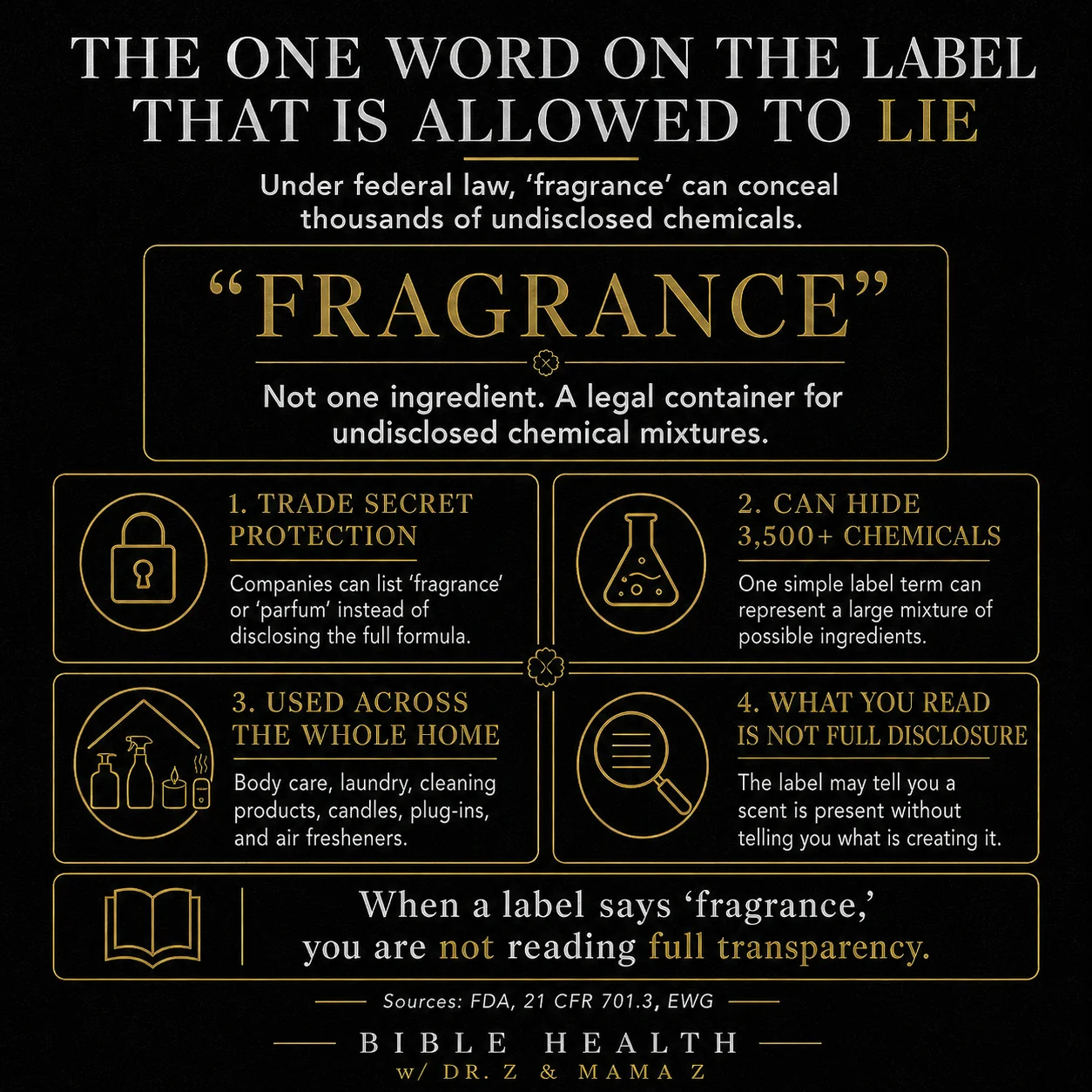
Pick up almost any bottle in your bathroom or laundry room and you will find a single word doing an enormous amount of hiding: fragrance, or sometimes parfum. Under federal law that one word is treated as a trade secret, which means a manufacturer can fold many separate chemicals into it without ever printing them on the label, and synthetic fragrance formulations have been documented to draw from a palette of more than three thousand possible ingredients.
That’s worth repeating…
“Fragrance” is legally allowed to hide a cocktail drawn from more than 3,000 chemicals.
That exemption is not some recent oversight either. It was written into the federal cosmetic labeling rules that took full effect in 1977, the same rules that to this day let a company list “fragrance” instead of what is actually in the bottle, which means the loophole has stood almost untouched for nearly fifty years, long enough that the young mothers who first trusted it are grandmothers now.
The Environmental Working Group has spent years explaining that this loophole lets companies keep the actual contents of a scent legally invisible, and Breast Cancer Prevention Partners and the broader safe-cosmetics researchers have shown the same thing from a different angle.
So when you read a label and see “fragrance,” you are not reading an ingredient at all. You are reading permission, granted by law, for a company to not tell you what is in the product you are about to rub into your skin or breathe into your lungs.
This is exactly the kind of claim Scripture trained us to test rather than swallow, and we walked through that whole filter of testing health advice before you trust it in our piece on the one filter every Christian needs for health claims.
Why the “Cleanest-Smelling” Homes Are Often the Most Polluted
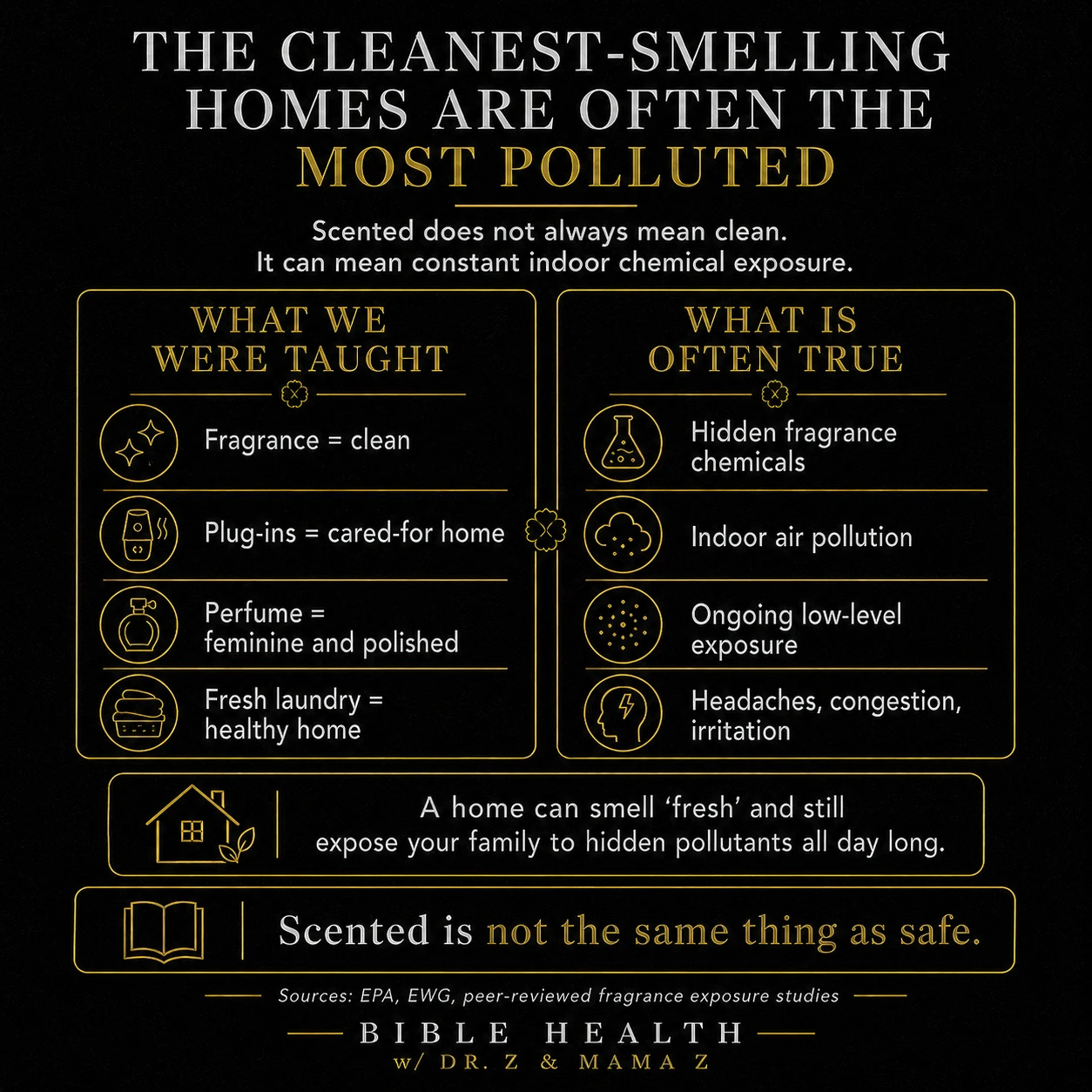
Here is the part that genuinely surprised us when we first dug into it years ago. The Environmental Protection Agency reports that Americans spend over 90% of their lives indoors, and that the air inside our homes is 2-5x more polluted than the air outside, and occasionally far higher than that.
The home we built to be our refuge is often the most chemically concentrated room we step into all day.
Scented products are a big reason why. Because they are in everything.
You’ll find artificial fragrance all over your home:
Body care
Cleaning products
Plug-ins and room sprays
Kids’ toys and art supplies
Laundry detergents and dryer sheets
Candles and wax melts
Dish soaps and dishwasher pods
Trash bags and air fresheners
Baby wipes and diapers
Shampoo, conditioner, and styling products
Lotions, deodorants, and perfumes
Toilet paper, tissues, and feminine care products
Pet products
Car fresheners
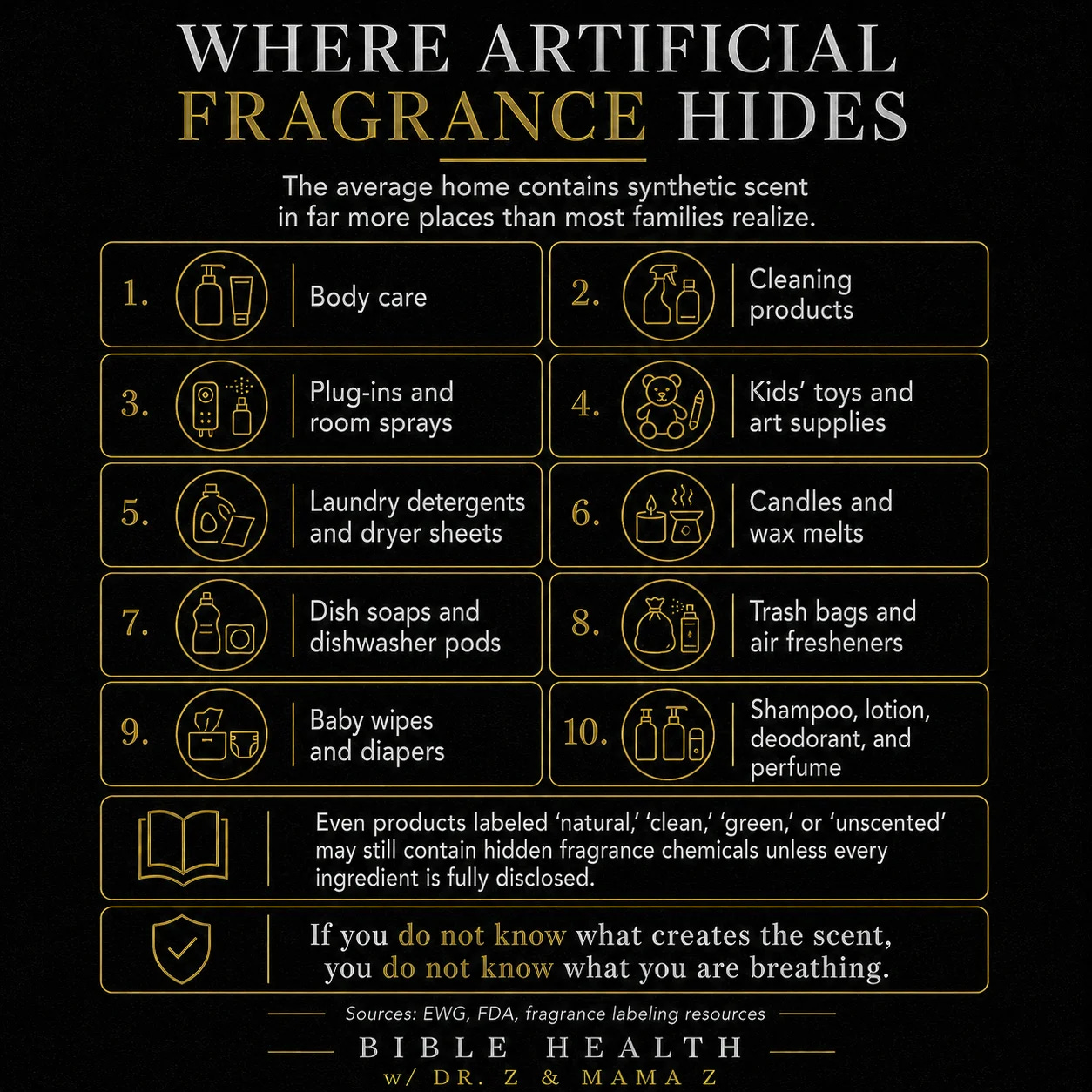
Even products labeled “natural,” “clean,” “green,” or “unscented” can still contain hidden fragrance chemicals unless the label clearly discloses every ingredient. That one little word, “fragrance,” can represent dozens or even hundreds of undisclosed chemicals in a single product.
When researchers measured what fragranced consumer products actually emit, they found that each product tested released between one and eight chemicals classified as toxic or hazardous, most of them never named anywhere a shopper could see.
Scented candles and air fresheners make it worse in a way most people never hear about, because the limonene that gives so many products their bright, clean smell reacts with the small amount of ozone already drifting through indoor air and forms brand-new pollutants, including formaldehyde and ultrafine particles that were never in the candle to begin with.
This is the same cumulative load we keep coming back to, the bucket the body can only drain so fast before it spills over into symptoms. Fragrance is rarely the only thing in that bucket, but in most homes it is one of the steadiest streams pouring in, hour after hour, while everyone breathes and nobody suspects a thing.
“I’m grateful to be here, receiving encouragement, recipes, and whole-body transformation. Even after trying times, I trust you and Mama Z. The spiritual aspect completes the system: body, soul, and spirit.”
— Ellen D.
God Made You This Way
Are you drawn to pretty colors, beautiful packaging, and nice-smelling products?
That is not foolish. That is by design.
God made the human body with senses that help us notice beauty, detect danger, enjoy food, remember people and places, bond with loved ones, and move through the world with discernment. Pain is one of those gifts.
When you touch something hot, your hand pulls away before you stop to think about it, because the body is designed to protect itself from harm.
Smell works in a similar way.
Smell, or olfaction, is one of the most ancient and primal sensory systems in the body. Long before ingredient labels, warning signs, air-quality monitors, and online reviews, the body had smell.
That primal sense helped humans recognize food, smoke, decay, mold, waste, spoiled food, infection, environmental danger, and the difference between something nourishing and something harmful.
Olfaction is not just about preference.
Your sense of smell is part of the body’s God-given discernment system.
This is why smell is so deeply connected to emotion and memory. Olfactory signals are closely tied to the amygdala and hippocampus, areas of the brain involved in emotional learning, memory, and threat detection.
Color matters too. Researchers have studied how color vision helps humans and other creatures notice food, plants, warning signals, and emotionally meaningful cues in the environment.
That is why a scent can carry you back to your grandmother’s kitchen with fond memories and positive feelings.
It is why the smell of a newborn, a blooming magnolia, fresh herbs, rain on the ground, or clean sheets can feel so comforting.
“See, the smell of my son is as the smell of a field that the LORD has blessed!” — Genesis 27:27
“The flowers appear on the earth, the time of singing has come… The fig tree ripens its figs, and the vines are in blossom; they give forth fragrance.” — Song of Solomon 2:12-13
It is why a beautifully colored bottle with a “fresh” fragrance can feel safe, clean, and trustworthy before you ever read the ingredient label.
But here is the problem: modern marketing knows this about you.
The fragrance industry did not create your attraction to scent. It learned how to use it.
Product designers know that scent and color can shape how we feel about a product. A cleaner that smells like lemons feels “clean.”
A lotion that smells like vanilla feels “comforting.” A plug-in that smells like pine feels “natural.”
A pastel bottle with flowers on the front feels gentle, even if the ingredient list tells another story.
This is where discernment matters.
Because when you walk into a bathroom that has just been sprayed with artificial fragrance, or a laundry aisle saturated with scented detergents, or a home filled with plug-ins and candles, your body may respond before your mind has time to explain why. A headache, nausea, watery eyes, sneezing, coughing, chest tightness, congestion, or a runny nose are not always signs that someone is “too sensitive.”
Sometimes they are signs that the body is recognizing something it does not want to breathe.
And if those smells no longer bother you at all, that is not automatically a sign that your body is stronger.
It may mean your warning system has been dulled.
Said more boldly…
“If you do not experience some sort of negative reaction when breathing air heavily polluted with artificial fragrance, that is not a good sign. It most likely means you have desensitized your olfactory system and have dulled that God-given discernment to instantly recognize that the environment you’re in is dangerous.”
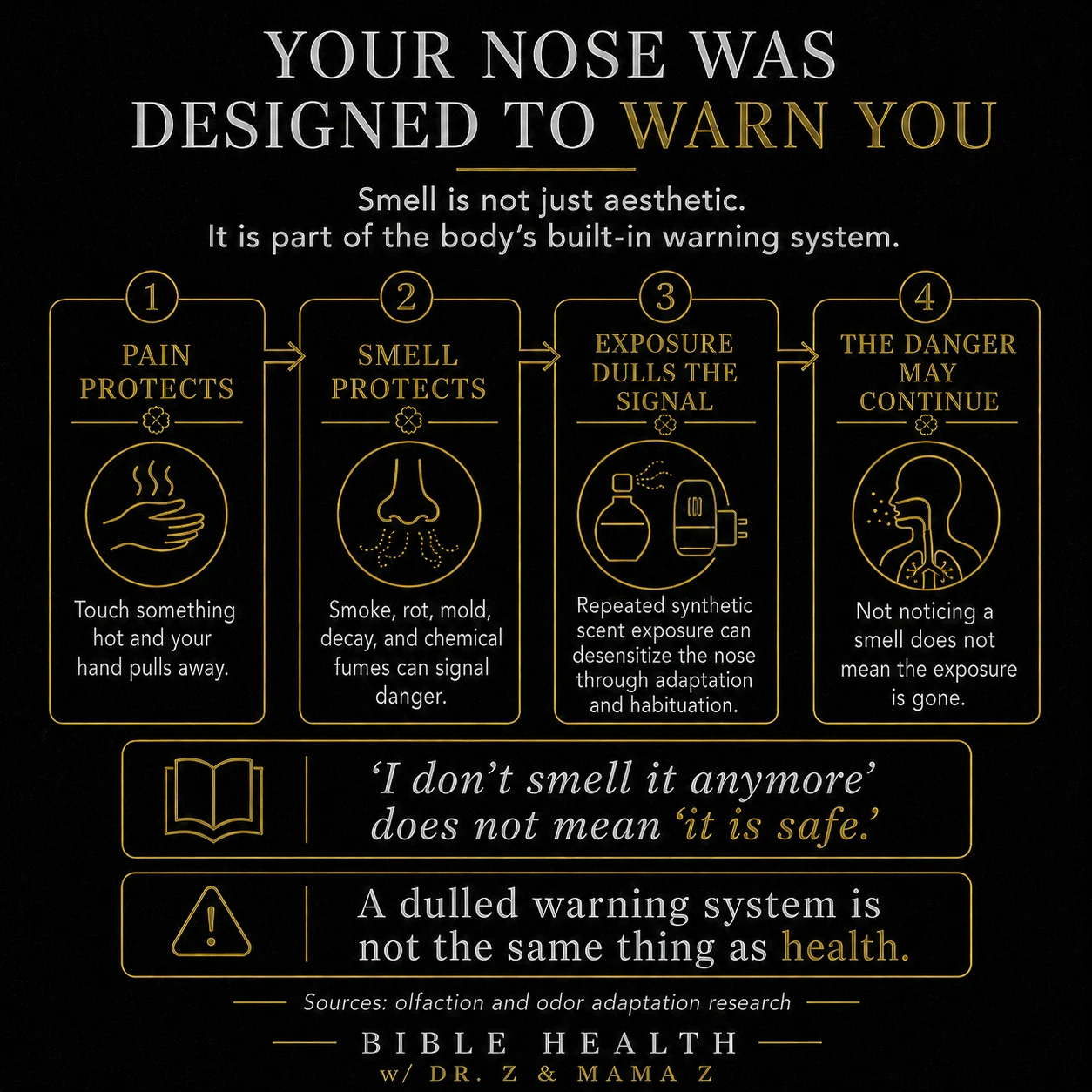
Researchers describe this as olfactory adaptation or habituation, where repeated exposure to an odor reduces the perceived intensity of that odor over time. In plain English, your brain can learn to tune out a smell even while the chemicals are still in the air.
That is why your own laundry detergent may not smell strong to you, while a guest can smell it the moment they walk through the door. That is why a plug-in can disappear into the background of your home while still releasing fragrance chemicals into the air your family breathes.
“I don’t smell it anymore” does not mean “it is not there.”
And “it does not bother me” does not automatically mean “it is safe.”
God gave us smell as a gift. He filled creation with real aromas: flowers, spices, herbs, fruit, trees, soil, food, and the people we love.
But artificial fragrance takes that God-given pathway and floods it with undisclosed chemical mixtures that can be hidden behind one innocent-looking word: “fragrance.”
So the issue is not that you like beautiful things.
The issue is that modern companies often use beauty, scent, and emotional memory to make synthetic products feel safer than they really are.
And when the body stops recognizing the difference between real clean and chemical perfume, that is not wisdom.
That is a call to wake the senses back up.
You Take 20,000 Breaths a Day, and Fragrance Rides Every One
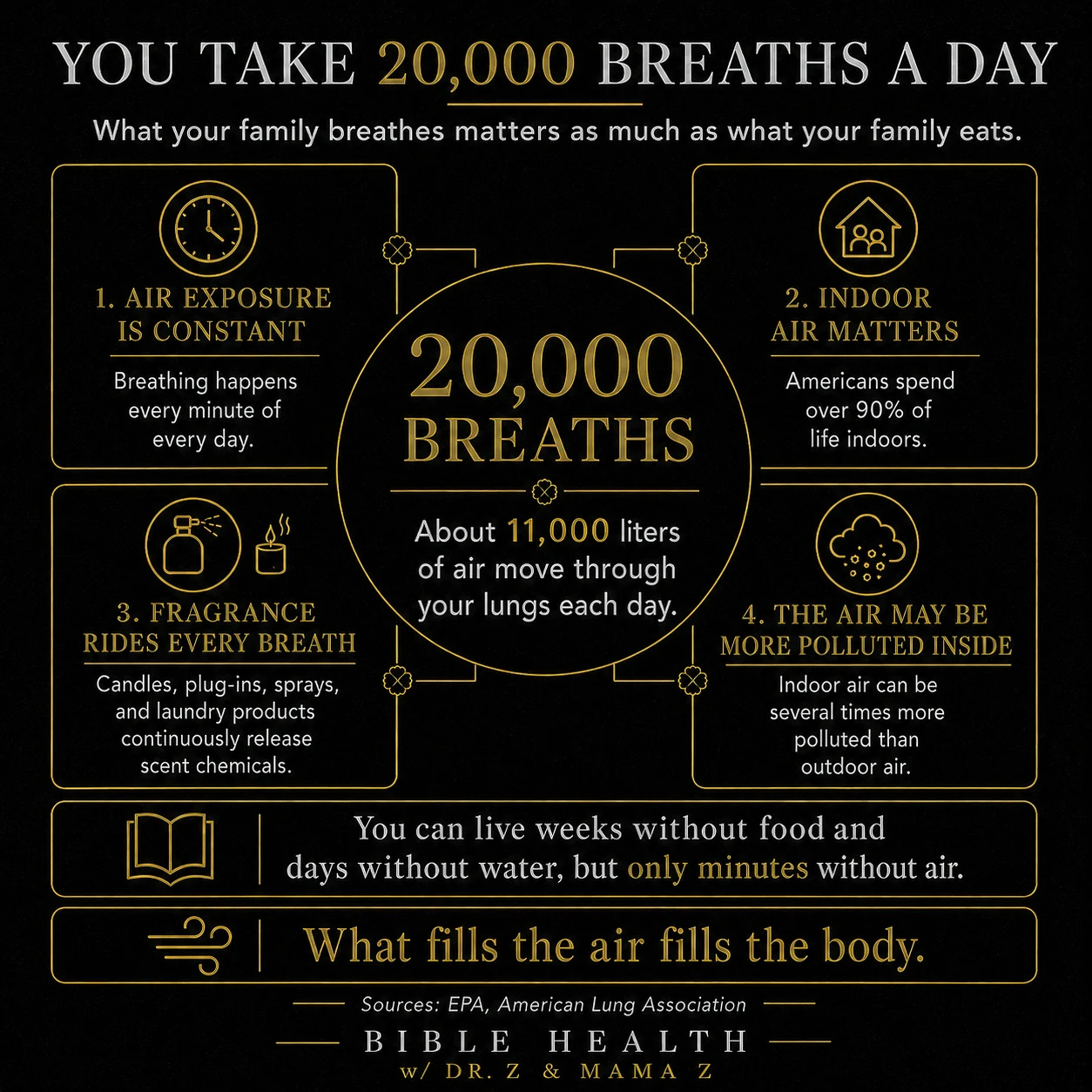
Here is why we refuse to treat this as a small thing. You can live for weeks without food and for days without water, but you will not last more than a few minutes without air, which tells you how central breathing is to whether the body thrives or slowly breaks down.
By the common estimates we draw something like twenty thousand breaths and around eleven thousand liters of air through our lungs every single day, and every one of those breaths is either carrying something clean into the body or carrying something harmful. That is the whole reason artificial fragrance belongs at the very top of the list of things worth dealing with, because in our honest opinion, after more than twenty years in this work, it is the single worst everyday chemical exposure most families carry, and at the same time the very easiest one in the entire house to simply walk away from.
The route these chemicals travel is what makes inhaling them so serious. When scented candles and plug-ins throw off the ultrafine particles we just described, those particles do not politely stay in the nose, because researchers have shown that inhaled ultrafine particles can travel along the olfactory nerve straight from the nasal passages into the brain, taking a back road that slips past the blood-brain barrier the body built to keep invaders out, while the same chemistry rides deep into the lungs with every breath.
The food you eat at least gets filtered by the gut and the liver before it ever reaches your bloodstream, and the air you breathe gets none of that inspection, which is exactly why what your family breathes deserves every bit as much attention as what they eat.
The toll on the lungs shows up in ordinary homes far more than most people realize. In a nationally representative survey, more than a third of people reported a real health problem, a migraine or a breathing difficulty, after exposure to a fragranced product, and among people with asthma that number climbed past sixty percent.
Forty-one percent of those asthmatics named air fresheners specifically, and nearly thirty percent named the scented laundry products venting out of a dryer, while separate research has linked the phthalates that off-gas from scented products to asthma and allergic airway inflammation in children.
So if you have a little one whose nose is always a little congested, the candles and the plug-ins and the dryer sheets are worth questioning before you decide that is simply how he is built.
Fragrance Is an Obesogen, and Your Body Already Knows It
The chemicals most often used to make a scent last are called phthalates, and phthalates are endocrine disruptors, which is a precise way of saying they interfere with the hormone signaling that runs almost everything in your body. Researchers have tied higher phthalate exposure to altered sex-hormone levels in women across national survey data, to reproductive and developmental harm, and to a category of chemicals that scientists now call obesogens, meaning compounds that nudge the body toward storing fat and gaining weight no matter how carefully you eat or how hard you work.
Fragrance is an obesogen.
That is not our slogan, it is the direction the peer-reviewed literature has been pointing for years, with phthalate metabolites turning up next to wider waistlines and stubborn weight gain in large studies of American adults and adolescents.
“Do you not know that your body is a temple of the Holy Spirit within you, whom you have from God? You are not your own, for you were bought with a price. So glorify God in your body.” — 1 Corinthians 6:19-20
We do not quote that verse to guilt anyone, because the same data that names the problem also names the way out. The body that the chemicals are quietly scrambling is the very temple God said He dwells in, and the science of how phthalates interrupt its hormone signaling is, in the most literal sense, a description of the temple being defiled by something we invited in without knowing.
When the research and the Scripture say the same thing in the same breath, we have learned to listen.
What That One Word Has Been Linked To
Now hold onto something, because this is the part the industry would prefer you never connect. The chemicals hiding inside that one word are not gentle little scent molecules that drift off and disappear.
They are the same endocrine disruptors we have been describing, and the peer-reviewed research has tied them, study after study, to the very diseases filling our clinics and our prayer chains:
It has been measured, not just theorized: When Breast Cancer Prevention Partners had a set of name-brand products independently lab-tested, the analysis found 338 separate fragrance chemicals hiding inside them, and 99 of those were already linked to health concerns including cancer, hormone disruption, and reproductive harm, with not one of them printed on a label.
Heart attack and stroke: A 2025 analysis published in the Lancet journal eBioMedicine estimated that exposure to a single common phthalate, DEHP, contributed to roughly 356,000 cardiovascular deaths worldwide in one year, more than thirteen percent of all heart-disease deaths among adults aged 55 to 64, because these chemicals drive the kind of inflammation in the arteries that ends in a heart attack or a stroke.
Diabetes: Across repeated national NHANES analyses, higher urinary phthalate levels have been associated with insulin resistance, larger waistlines, and a meaningfully higher rate of diabetes, with some of the clearest signals showing up in women.
Cancer: When researchers captured what fragranced products actually release into a room, nearly half gave off at least one chemical on the federal list of carcinogenic hazardous air pollutants, including formaldehyde, which the National Cancer Institute classifies as a known human carcinogen.
Autoimmune disease: A growing body of research is connecting these same endocrine-disrupting chemicals to immune-system dysregulation and to the modern rise of autoimmune conditions, which strike women far more often than men, a pattern scientists increasingly suspect is tied to chemical exposure rather than to chance.
We will be honest with you the way we always try to be, because honesty is how we keep your trust. Most of this research shows strong association rather than the kind of courtroom-grade proof that takes decades to nail down, and any careful scientist will tell you so plainly.
Yet when the very same family of chemicals keeps turning up beside heart disease, diabetes, hormone disruption, and cancer in study after study, the wise move is not to keep breathing it while we wait for perfect certainty, but to test everything, hold fast what is good, and quietly clear out what we reasonably can.
“Thank you so much for everything you all do, and especially today for the Scriptures. I really needed those today.”
— Mary G.
The Year Our Home Almost Broke Us
We did not arrive at any of this from a place of expertise, we arrived at it from a place of pain. Back in 2016 we were renting a home with toxic black mold growing in the basement, and it made Dr. Z and three of our children genuinely sick, with Dr. Z fighting pneumonia and the whole family cycling through months of illness we could not explain.
That season strained our marriage to a place we never want to revisit, and we have told the hardest parts of it before in the story of the year that nearly cost us everything. What the mold did, underneath the suffering, was finally open our eyes to the air our family was breathing every single day.
So we started removing, which is the third of the Seven R’s and the one this whole topic lives under. Dr. Z’s instinct, the way it almost always is, was to throw it all out at once and start with a clean slate, while Mama Z wanted to go room by room and swap things one at a time as they ran out.
Both of those are right, and you get to choose your own pace, because the goal is a home that heals you rather than a guilt trip about how fast you got there.
Over the ten years since, we have tightened it steadily, until today we keep high-powered air purifiers running in every room, no plug-ins anywhere, and only essential-oil diffusers when we want our home to actually smell like something. We will tell you plainly that even the bags labeled “unscented” often still carry a detectable fragrance, because the manufacturers are not always telling the truth, which brings us right back to that one word on the label.
And here is the fact that ought to stop every American mother in her tracks. The European Union has banned or restricted more than thirteen hundred chemicals from cosmetics and personal-care products, and several of the phthalates still woven into American fragrance sit on that banned list.
The United States has restricted roughly a dozen.
Take one concrete example: a synthetic fragrance ingredient called lilial was used for years in perfumes, lotions, and shampoos until the European Union classified it as a reproductive toxicant and banned it from cosmetics in 2022, and yet that very same chemical was never pulled from American shelves the same way, where it can still ride into your home hidden under nothing but the word fragrance. The same brand on the same shelf is often quietly reformulated to be cleaner for a mother in Paris or Berlin than the version handed to a mother in Atlanta, and that is not because our children are made of sterner stuff.
It is because our law is weaker, and the burden of figuring it out has been left on you, armed with nothing but a label that is allowed to keep its secret.
What Happens in Just Three Days When You Stop
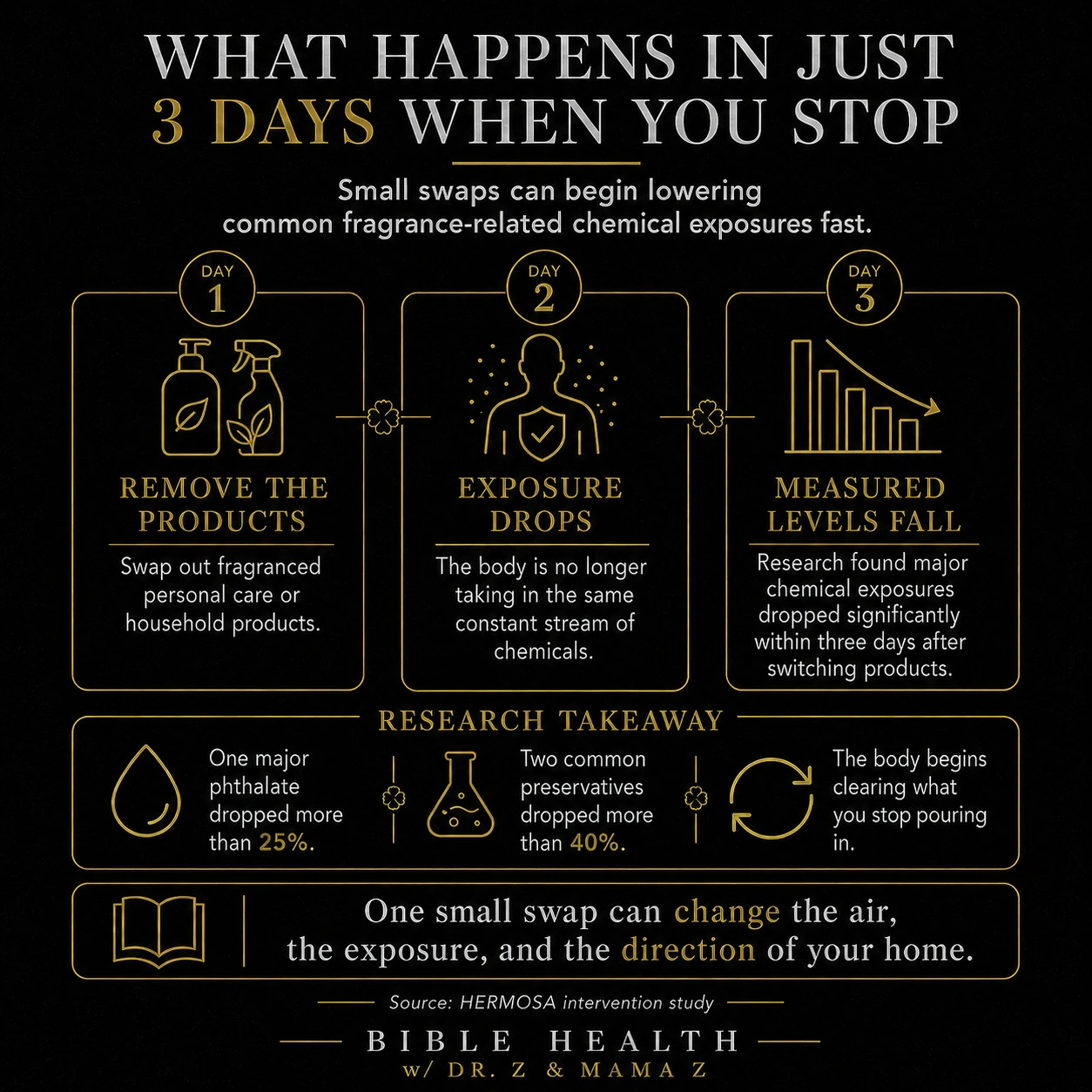
This is the part that fits everything we believe about feeling better today instead of five years from now. A group of researchers ran an intervention with teenage girls, simply switching them to personal-care products free of these chemicals, and after only three days the level of one major phthalate in their bodies dropped by more than a quarter, with two common preservatives falling by over forty percent each.
Three days.
The body is not a sealed container that holds onto this forever, it is a living temple designed to clear what you stop pouring in, and it starts the moment you give it the chance. The swap does not have to be complicated to count, and one of the easiest places to begin is the product you reach for every single morning, which is why Mama Z has made our own two-ingredient deodorant base for years instead of buying the scented kind.
There is a mercy built into how God made us, and it shows up in your nose. The reason your scented home stopped smelling strong to you is a real phenomenon called olfaction desensitization, where constant exposure dials down your sense of smell until you genuinely cannot detect what a visitor notices the second they walk in your door.
When you remove the synthetic fragrance and give it a couple of weeks, that warning sense comes back online, and most people are stunned by how quickly their afternoon headaches ease and their sleep deepens once the air clears.
“Since we have these promises, beloved, let us cleanse ourselves from every defilement of body and spirit, bringing holiness to completion in the fear of God.” — 2 Corinthians 7:1
We will gently say one thing about Sunday morning, and then we will leave it with you and the Lord. Many of us have learned to layer on perfume before church and to keep a candle burning beside the Bible while we pray, treating the scent itself as part of the reverence, and there is no shame in any of that, because nobody handed us the information.
Throughout the Bible aroma is connected with worship, but not in the shallow way our culture often does. David prayed:
“Let my prayer be counted as incense before You…” — Psalm 141:2
In Revelation, incense is connected with the prayers of the saints. The point was never that God is impressed by a scented room.
The point is that prayer, surrender, and holiness rise before Him.
“And when He had taken the scroll, the four living creatures and the twenty-four elders fell down before the Lamb, each holding a harp, and golden bowls full of incense, which are the prayers of the saints.” — Revelation 5:8
The point is simply that the places where we feel most spiritual are not automatically the places with the cleanest air, and the God who asks for our bodies as living sacrifices is honored when we steward the temple even in the small, unglamorous, ordinary decisions like which bottle we reach for on the way out the door.
What God Gave Us to Reach for Instead
We are not asking you to live in a home that smells like nothing, because that is not the world God made. He filled creation with real fragrance, the cedar and the myrrh and the cinnamon, and when He handed Moses the recipe for the holy anointing oil, He named actual plant oils and called for them to be blended by a perfumer.
“And you shall make of these a sacred anointing oil blended as by the perfumer; it shall be a holy anointing oil.” — Exodus 30:25
That verse holds the whole difference in a single line. The scent inside a plug-in was engineered in a lab to fool your nose for as long as the manufacturer can manage, while the scent inside a bottle of real essential oil came straight out of a plant God designed.
The Bible tells us that when Mary anointed Jesus with costly ointment, “the house was filled with the fragrance.” Scent can be part of worship, memory, honor, and love.
But again, Scripture is speaking of real aromatic substances, not undisclosed synthetic mixtures engineered to cling to clothing, disrupt hormones, and deceive the senses.
“The house was filled with the fragrance of the perfume.” - John 12:3
Paul even uses fragrance as a picture of spiritual influence. He says God spreads “the fragrance of the knowledge of Him everywhere.”
That is the aroma we want our homes and lives to carry first: Christ, peace, holiness, hospitality, truth, and love. A Christian home does not need synthetic perfume to smell cared for.
It needs the presence of God, clean air, real ingredients, and wise stewardship.
“Through us spreads the fragrance of the knowledge of Him everywhere.” - 2 Corinthians 2:14
We have used essential oils in our own home for more than twenty years, not because they are trendy, but because they let us fill the house with cedarwood or orange or lavender without a single hidden chemical riding along, and a few drops in a diffuser does everything the plug-in promised while hiding none of what it hides.
We do want to say this plainly, because we are not in the business of trading one careless habit for another. Essential oils are concentrated plant chemistry, which is exactly why they deserve respect rather than hype, and they are not toys, not magic, and not a substitute for real medical care.
Used with wisdom, though, they let a family enjoy genuine aroma without the cocktail behind the word fragrance, and here is the practical line we actually walk in our own home:
Avoid anything that lists artificial fragrance, parfum, or a vague “fresh scent” without disclosing what creates the smell.
Choose truly fragrance-free products where it matters most, especially in the laundry, the bedroom, and anything made for babies, children, or anyone with asthma, migraines, or hormone concerns.
Use essential oils intentionally rather than constantly, and buy from companies that openly disclose their purity testing and their sourcing.
Diffuse lightly and keep the room ventilated, because more is never better with something this concentrated.
Dilute before any topical use, respect age and pregnancy precautions, and keep oils well away from the eyes and ears.
Natural has never meant careless, and stewardship simply means choosing what is better and then handling it with wisdom. If the whole idea feels intimidating because you have never worked with them, start small, so you can trade the synthetic for the real without any guesswork.
Start with one oil you love, diffuse it in the room you just cleared, and let your home finally smell like something God actually made.
Scripture’s highest language of fragrance is not cosmetic. It is sacrificial.
Christ gave Himself as “a fragrant offering and sacrifice to God.” That should reorder the whole conversation for us.
We do not need to cover our homes, bodies, and churches in artificial scent to make them acceptable. We need lives offered to God, bodies stewarded with wisdom, and homes cleared of what quietly harms the people inside them.
“Christ loved us and gave Himself up for us, a fragrant offering and sacrifice to God.” — Ephesians 5:2
A Prayer for You. 🙏
Father God, thank You for the gift of every breath and for the senses You designed with such care.
Give me wisdom to fill my home with what is pure and good, and to care for the bodies of the people I love.
Thank You for the aroma of Christ, and let my home carry the sweet fragrance of Your presence.
Guide me in simple, faithful changes that help my family feel better today.
Amen.
Upgrade and learn what God’s Word says about every area of life
and how to live it. That’s what Bible Health is all about.
Walk each 6-week live group study the day it opens.
Get the Blueprint and every weekly Swap.
Follow Jesus, not trends, in every area.
As always, our hope and prayer is that you experience the abundant life.
~ Dr. Z & Mama Z
References
• https://www.epa.gov/indoor-air-quality-iaq/inside-story-guide-indoor-air-quality
• https://www.epa.gov/report-environment/indoor-air-quality
• https://www.ewg.org/news-insights/news/ask-ewg-what-fragrance
• https://www.law.cornell.edu/cfr/text/21/701.3
• https://www.safecosmetics.org/resources/health-science/fragrance-disclosure/
• https://www.safecosmetics.org/chemicals/fragrance/
• https://www.safecosmetics.org/chemicals/phthalates/
• https://www.bcpp.org/resource/right-to-know-exposing-toxic-fragrance-chemicals-report/
• https://nyulangone.org/news/heart-disease-deaths-worldwide-linked-chemical-widely-used-plastics
• https://www.bcpp.org/resource/cosmetic-fragrance-and-flavor-ingredient-right-to-know-act/
• https://pmc.ncbi.nlm.nih.gov/articles/PMC5773620/
• https://pubmed.ncbi.nlm.nih.gov/29391919/
• https://pmc.ncbi.nlm.nih.gov/articles/PMC5093181/
• https://link.springer.com/article/10.1007/s11869-020-00928-1
• https://pmc.ncbi.nlm.nih.gov/articles/PMC5047791/
• https://pubmed.ncbi.nlm.nih.gov/26947464/
• https://pmc.ncbi.nlm.nih.gov/articles/PMC6037613/
• https://pmc.ncbi.nlm.nih.gov/articles/PMC7969426/
• https://pmc.ncbi.nlm.nih.gov/articles/PMC6701840/
• https://pmc.ncbi.nlm.nih.gov/articles/PMC4114051/
• https://pmc.ncbi.nlm.nih.gov/articles/PMC5359373/
• https://pmc.ncbi.nlm.nih.gov/articles/PMC10779569/
• https://pmc.ncbi.nlm.nih.gov/articles/PMC11578596/
• https://pmc.ncbi.nlm.nih.gov/articles/PMC3018511/
• https://www.sciencedirect.com/science/article/abs/pii/S0045653524012372
• https://pmc.ncbi.nlm.nih.gov/articles/PMC2453150/
• https://pmc.ncbi.nlm.nih.gov/articles/PMC6791917/
• https://pmc.ncbi.nlm.nih.gov/articles/PMC6296560/
• https://www.niehs.nih.gov/health/topics/agents/endocrine
• https://pubmed.ncbi.nlm.nih.gov/34654571/
• https://pmc.ncbi.nlm.nih.gov/articles/PMC3440117/
• https://pmc.ncbi.nlm.nih.gov/articles/PMC1892109/
• https://pmc.ncbi.nlm.nih.gov/articles/PMC9472300/
• https://pmc.ncbi.nlm.nih.gov/articles/PMC8021784/
• https://pubmed.ncbi.nlm.nih.gov/37224951/
• https://www.sciencedirect.com/science/article/pii/S1438463925001865
• https://pubmed.ncbi.nlm.nih.gov/15204759/
• https://pmc.ncbi.nlm.nih.gov/articles/PMC12675173/
• https://www.lung.org/blog/how-your-lungs-work
• https://www.ncbi.nlm.nih.gov/books/NBK92786/
• https://www.ncbi.nlm.nih.gov/books/NBK55967/
• https://pmc.ncbi.nlm.nih.gov/articles/PMC4330889/
• https://pmc.ncbi.nlm.nih.gov/articles/PMC5039451/
• https://pmc.ncbi.nlm.nih.gov/articles/PMC5093181/
• https://link.springer.com/article/10.1007/s11869-020-00928-1
• https://www.sciencedirect.com/science/article/abs/pii/S0031938416307272
• https://link.springer.com/article/10.3758/BF03213109
• https://pmc.ncbi.nlm.nih.gov/articles/PMC4383146/
I am allergic to fragrance and it is very difficult going out in public or to someone else's house because of it. How are we to navigate that which we cannot control? A business is not going to change their practices for me, nor would I feel comfortable asking someone else to get rid of the fragrances in their home if I am merely a visitor.
The lilial example is the one that should travel farther than it does.
Banned across the EU in 2022 as a reproductive toxicant, still available here under nothing but the word fragrance.
That is the whole US/EU gap in one ingredient.